Categories
Technology

Windows 8 – First Impression

I.Doubt.It - installing untried, unstable software so that you don't have to. Not that you ever had to.

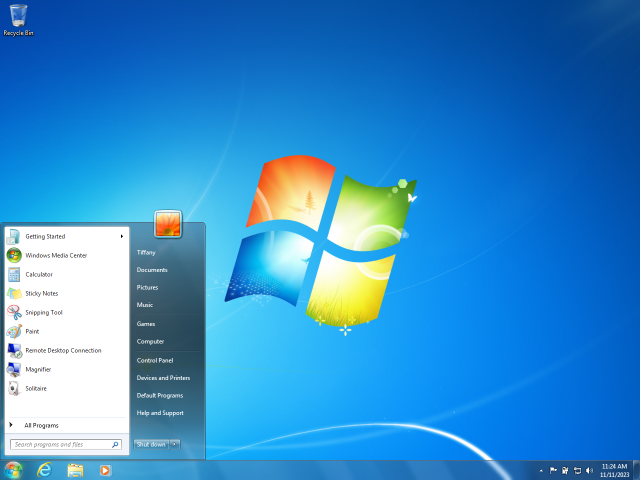
It’s like being a year into the future – probably more, the way these things tend to go. I’m writing this on a computer running Windows 8, the OS that is meant to get Microsoft back to the forefront of personal computing. On Windows 8, the complex and resource-hungry operating system of the past will be pushed into the back seat. The front end of your PC is going to be more like a… well, more like an iPad. More like a phone, or other lightweight browsing device. The main “Metro” interface is attractively tiled with little apps to do the little things you probably spend the larger part of your time doing. A basic browser, games, Twitter client, news feed reader, Facebook app, that sort of thing.

I have to preface my remarks with a caveat: It is not a fair test by any means. This is what Microsoft calls a Developer Preview, and it’s being released now, long before its ready even for beta testing, to give programmers a better idea of the forthcoming look and feel. Nonetheless I can start with unreservedly good news. This really does seem to be the lightest that Windows has been for some time. The spec of this computer is dated (1.2 GHz single core processor and 1.5 GB of memory), merely adequate for XP, yet XP’s great-granddaughter seems to run as well if not better. In the past I’ve used this or fairly similar hardware to test the betas of both Vista and Windows 7, but this pre-beta is more immediately impressive than either.

There aren’t a lot of other obvious changes from 7; perhaps the most notable is that the “ribbon” from Office is now in Windows Explorer. Version 10 of IE on the other hand is refreshingly clean and simple – and frighteningly fast. But of course we’re mainly here to get to grips with that weird new interface. Microsoft says it requires a multi-touch screen, but I’ve been getting by with pen input or just a mouse – Metro provides a scrollbar when needed. Presumably there are multi-touch gestures I’m missing out on. Indeed my first impression was that some such two-fingered salute must be a vital part of the interface, because for the life of me I could find no way to get those cool little apps to shut once I’d opened them.

That was when l discovered perhaps the strangest aspect of the future Windows: These apps are not meant to close. They stay suspended in the background, ready to spring back to life from wherever you left off. Which means of course that they use memory while they’re suspended, and I wonder how much they will be allowed to squander before something is done about it. Presumably the oldest will eventually be shoved onto the hard disk. If you’re desperate for memory right now you can kill them from a new-look Task Manager, but that seems a bit ad hoc.

To use the new “Metro” interface, you need to discover a couple of gesture controls that might not be immediately obvious: A stroke from either the top or bottom (with the mouse, a right-click) brings up a sort of context menu / taskbar in any app. A stroke inwards from the left edge (or touching the edge with the mouse) swaps between the two most recently-used apps – one of which can be the desktop – and most important of all, a stroke from the right (or bringing the mouse to the bottom left corner) opens the replacement for the old Start Menu. This though could hardly be more different. It holds just five icons, the main one returning you to the tiled Metro interface – which of course is the real replacement for much of the Start Menu’s functionality. Here you will find shortcuts to “traditional” application programs as well as the new apps.

Weirdly though, I found the lightweight Metro interface a little sluggish and unresponsive compared to Windows 8 proper. Pen input, smooth as silk otherwise (I’m writing this using the handwriting recognition and it works astonishingly well) is jerky in apps. Perhaps it makes too much demand on my Centrino-era graphics hardware. But if it’s still a little rough, it’s also surprisingly usable and interestingly different. Tomorrow, if you’re good, I’ll tell you how to start using Windows 8 yourself.

Categories
Politics

Is The Norris Campaign Unfinished?

Senator Norris, Here Seen Fondling Some Of My Cartoon Characters

Last night Senator David Norris made a play to revive his bid for the Presidency. Did he do enough?

His interview on Ireland’s Late Late Show was a robust one. Excessively so some thought, but really it could hardly have suited him better. Certainly he was asked tough questions; about the way he acted when his ex was convicted of statutory rape, about quotes attributed to him concerning underage sex. But these were exactly the questions he needed to face publicly if he was to have any hope of competing again.

He even volunteered answers to questions presenter Ryan Tubridy fought shy of asking. In order to contextualise his remark about wanting to be “molested” when he was a child, he brought up the fact that it is quite normal for younger people to fantasize about older. His new, hard-won political experience showed through here though. He didn’t actually say younger people, or adolescents, or teenagers. He said people “of 17 or 18”. People of legal age.

We all know that it is in fact perfectly normal for people years younger than the age of consent to fantasize about adults. We also know that it would have been political suicide for a middle-aged Gay politician to say what we all know to be true. It’s the sort of hypocrisy politics demands. And it will be good for his campaign, because it demonstrates he now has a level of political awareness that he demonstrably did not have when he wrote to the Israeli Appeals Court. This judicious use of half-truth shows he can play the game.

Which seems a little sad, but it is not completely unreasonable. We want a President who is circumspect, diplomatic, who can tell when he’s on the verge of saying something that will scandalize and hold back, who isn’t going to spring any surprises when he’s representing the country abroad.

Well OK, most people want that. Personally I want a President who comes out with stunningly undiplomatic but heartfelt opinions and makes gleefully off-colour sexual remarks – preferably about other people’s Presidents. But we shouldn’t always get what we want.

Categories
Technology

New Windows 2 – The Ecosystem

windows 8 preview
A Glimpse Of The Future

Perhaps as early as next year you will be able to run Windows on the same sort of low-energy ARM processors that iPads and phones use. Interesting.

What exactly is the point though? By itself, Windows for ARM doesn’t change a lot. All the programs that we use on Windows were written for Intel chips. They won’t run on ARM. They would have to be “ported” to the different architecture, and there’s no guarantee that a heavyweight program converted for a nimble processor would be anything you’d really want to use. Apple didn’t get where it is by simply porting Mac programs to the iPad. Garage Band, to take one example, is pretty much a wholly new version written to take full advantage of the touch interface.

It will be up to the market to create the software that really suits ARM-based Windows, and that of course depends on the platform taking off, which depends on the market… The Catch-22 of new technologies. Microsoft can seed it for success, but a huge amount of the detail still remains to be seen. It will surely run many Windows Phone 7 apps, but will it be able to take on the full-fat version of Office? (Rumours that it already can are probably based on an Intel tablet demo.) What about all the software created in Microsoft’s .NET framework? In Java?

Will it even have a desktop? This may seem an odd idea – Windows without a desktop? But in Windows 8, the desktop has been demoted to the status of an app; just another program, rather than an integral part of the operating system. Instead, the default interface of all Windows versions will be Metro, the “live tile”, highly touch-orientated look pioneered on Windows Phone 7. It’s all about fast and attractive access to information feeds. To do traditional work, with one or more heavy-duty application program running at once, you first open out a desktop. So it’s at least a possibility that the ARM-based version of Windows will only run lighter apps purposely designed for the touch interface. I am sure that “heavier” Intel versions of Windows will run those too though; Microsoft wants touch to be ubiquitous.

At the moment, leaving aside special-purpose and older versions, there are basically two Microsoft operating systems: Windows 7 and Windows Phone 7, and in most respects they’re distinct, incompatible things. In the near future though there could be a pretty continuous spectrum of Windows 8, over not two but four distinct types of device:

  1. Phones that can run lightweight touch-based apps.
  2. Light ARM-based tablets that can run the same apps – and some traditional software?
  3. Full Tablet PCs that definitely can run traditional software as well, but are still totally touch-orientated.
  4. Laptops and desktops that have an optional touch interface.

Hopefully they should all blend well so that data (and perhaps apps) move from one device to another seamlessly, even by touching them together. One can turn to the device suitable for your situation – a phone for walking, a desktop for work, a slate for sitting back – and find little changed about the user experience other than the size of the screen. It’s easy to see that merging very gracefully with “Surface“-type touch- and object-aware furniture. It’s as interesting as Windows has sounded for a very long time. Perhaps ever.

Categories
Cosmography Technology

Life In The Fast, Narrow, Dark Lane

Athenry North Gate 2009 09 13
You Are Now Leaving Athenry

Uhh. Just drove back from Athenry. The GPS did a great job, but it brought me by ways I knew not. A transaction based purely on trust. Our modernised country roads; beautifully paved and marked but still crazily meandering. Blind bends you round to find that they conceal other blind bends. In the dark. In the rain. A red dot following a purple line.

A microcosm of my life in the last few days, even weeks.

Probably months.

I didn’t know where I was and I only thought I knew where I was going. But somehow, I got home.

A transaction based purely on trust.

Categories
Technology

New Windows

Windows 7, the latest client version in the Mi...
A thing of the past

Since last we had a new version of Windows, the IT scene has changed beyond recognition. With the big growth areas now phone and tablet devices running operating systems from Apple and Google, Microsoft’s position as global software king has gone from undisputed to suddenly very vulnerable-looking. How will they respond?

Well what they’re not doing is reinventing themselves. Microsoft biggest asset is that they are already on the vast, vast majority of the world’s PCs and laptops. Their task therefore is to keep that position relevant.

Both Apple and Microsoft have distinct desktop and phone operating systems. With its latest desktop OS version though, Apple has integrated a lot of the phone version’s functionality, and it seemed obvious that Microsoft would have to do much the same thing. But they’re going about it in a fundamentally different way. Key to the difference is the two companies’ very distinct tablet strategies.

Microsoft actually pioneered the tablet computer. Theirs was launched back in 2002. The idea though was to put full-strength Windows on a device with a touch screen interface, using a pen and handwriting recognition instead of a keyboard. This actually works fantastically. The only problem is, it’s not a product that many people wanted to use. They’re great for work in the field, factory, site or hospital, because you can walk with them, enter text while standing, use them like paper with built in computing power. I have one because by day I’m an artist, and it means my sketchpad has Photoshop right there. But while it’s a wonderful product in a great variety of professional niches, it doesn’t have the broad consumer appeal that has made Apple such an incredible pile of money.

The key difference is that Microsoft decided that tablets should be full computers – they call them Tablet PCs – while Apple decided they should be large phones. Microsoft’s approach is more flexible, a Tablet PC can run any PC software. But the Apple approach had key advantages: Lightness, and long battery life. And it makes all the difference in the world. It took Apple to see the obvious: A device you hold in your hands needs to be light.

The chief reason for this is that the Apple-style tablet (under which I also include Android devices and other rivals) are built around ARM chips, whereas Microsoft’s tablets, like all PCs, use Intel’s x86 architecture. ARM was designed from the ground up with low power consumption to the fore of its priorities, while the x86 was built for speed without compromise. And though Intel have worked hard on producing x86 chips like the Atom with greatly reduced power demands, they will probably never be ideal.

Microsoft’s response was more radical than anyone expected. They’re going to bring out a version of Windows that will run on ARM chips – the same chips that are found in iPads and Android Tablets, and indeed in nearly all smartphones. It will be the first wholly new Windows version for many years – and the first break Microsoft has made with Intel, bringing an official end to what was once dubbed the ‘Wintel monopoly’.

But this is just one manoeuvre in a strategy. More to follow.

Categories
Cosmography

Interlude

Please excuse the brief interruption in service, owing to a family funeral. I’ll be back later today with a colour piece on what the well-dressed PC will be wearing next year.

Categories
Humour

Coincidence?

Yes!

But a weird one. As WordPress users may recognise, the graph is of blog traffic, and shows a sudden, mysterious peak starting on September 11.

Despite the date, the resemblance to a now-lost New York skyline is due not to readers eager for my opinions of 9/11 ‘Truthers’, but my piece on a whole other conspiracy theory.

Categories
Cosmography Politics

9/11 – New Revelations

Responding to my piece on 9/11 “Truthers“, reader Jeff Rubinoff had this to say:

I still think that the psychology of conspiracy theorists has a lot to do with it, probably because of the Truthers I know with no skin in the game (Brits, Irish, Slovaks…). A particular kind of (extreme) credulity that thinks it’s worldly cynicism. A sense of superiority that one has the “real truth” while the sheeple haplessly accept the official lies. And a complete lack of either the necessary knowledge to evaluate claims or a consciousness of this ignorance.
I have one friend who insists that WTC and the Pentagon were bombs, that the planes were generated by CGI, that a few bits of wreckage were planted in front of the Pentagon but clearly not enough and in too good a condition to come from an actual airplane attack: the most Byzantine, inconsistent and improbable pile of donkey dung imaginable. Of course, last time I met him he was telling me how he read on the Internet that the Pyramids were designed as chemical reaction chambers to send microwave signals into space, and how he found this “very persuasive.” Oh, and he’s a Holocaust denier.
He also told me once that University education only limits ones mental horizons, whereas the LSD he ingested daily over a similar period of time expanded his.

That’s also true. I was concentrating on the internal contradictions of the America-fearing American, but all conspiracists live with even deeper conflicts. As you say Jeff, they have a powerful faith which they think of as cynicism.

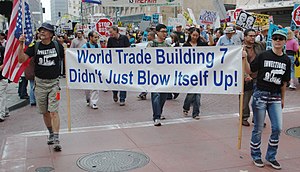
Apparently the official explanation is that WTC7 just blew itself up (Photo: Damon D’Amato)

I’ve said elsewhere, conspiracy theories seem to satisfy some of the same mental urges as religion. They are surprisingly like a mythos, in that they create exciting stories to explain the world about us. And just as religion, they provide the ultimate all-purpose explanation: Things difficult to explain can be seen instead as the manifestation of a powerful but invisible will. I’ll go out on a limb here and say that the idea of unseen will may actually be innate to the the human species, a built-in default hypothesis for about anything.

The thing making them different from religion though – or at least, traditional religion – is that the actors are not gods or spirits, but human. Still, perhaps conspiracy theories should be considered new materialist religions, belief systems for generations that, while still credulous, draw the line at the supernatural. (We’ll leave aside for now conspiracies that involve the influence of alien civilisations. These are supernatural beings in every sense that angels and demons are, just dressed from a contemporary costume box.)

But though the conspirators are not explicitly supernatural beings, they still have superhuman powers. They consistently pull off the scale of operation that non-clandestine organisations and governments usually seem to screw up. They have secrets that are never left in taxis or revealed by Wikileaks. They have superhuman powers of planning, efficiency, and organisation. Modern-day superpowers.

Hmm. They just don’t make gods like they used to.

Categories
Humour

Merry-Go-Roundup 2

no spam!
I do not like it

The last week was of course dominated by 9/11, its conspiracy theories especially, but my attention was also arrested by a court in England which created some rather unusual and onerous conditions of bail. I ranted somewhat about the extraordinary birthday arrangements for Ireland’s disgraced former leader Bertie Ahern, and got good and mad with what seems like an ever-rising tide of ever-more-tedious spam.

But I’d swear, writing about spam attracts more spam. And writing about conspiracy theories attracts weirder spam. Look at this one:

We have learned a great deal about recovering from narcotic addiction and have found several methods that work well. This is information drug treatment programs would not want out since it would cause them to lose a large number of patients.

The what now? Are they offering me drug rehabilitation, or drug rehabilitation as a business opportunity? I don’t want to know.

The surprise hit of last week though was the one about the cyberstalking of Eric Schmidt, executive chairman of Google. It was picked up by a couple of other sites, including the formidable Reddit and the forums of the veteran Ctrl+Alt+Del webcomic. This made it the single most-read post of the blog so far. Lovely stuff. I encourage you all to follow this example and spam other sites about I.Doubt.It.

Er, I didn’t say spam.

Categories
Cosmography Politics

September 11 – The First Ten Years

wtc
View onto a lost world

Ten years ago I spent this day with an online community, riveted to the events of September 11 even as some of our members were living through them in New York. Many moving things were said. Many terrible too – naturally we had one or two who wanted vengeance equal in horror to the attack. One actually did use the term “carpet bomb them into the stone age”.

But that was overwhelmed by the nobility of what most had to say, even as their country was being attacked. And not just the things they said, but what they did. Phones were out in New York, and some were frustrated to the point of tears that they couldn’t let their families know they were all right. Then someone had an idea – the rest of us could make the calls for them. The community proved itself that day.

I hope they do not mind if, ten years on, I repeat some of their words here.

I’m sitting watching the sky get dark from the smoke of the third building collapsing, and seeing a layer of soot settling on the cars and sidewalks. Soot that might be skin and bone and hair and burnt fragments of family pictures.
I haven’t got to the anger and revenge part of the process yet. I’m thinking of the mommy and daddy who are right now dying under 110 stories of rubble, while their kids are waiting in some school cafeteria to be picked up.
And I’m buoyed by the simple acts of grace and humanity shown by most of the folks on this board, offering to make phone calls and expressing true concern.
Sleep and food don’t seem to be very necessary things. But solidarity and human-ness sure are.
Defending a home is as close to pure animal instinct as most civilized humans get, and that’s as it should be, I imagine.
But in the defense of principles, on the contrary, we must behave as principled people, we must act as rationally and intelligently as we have the capacity to muster.
I’ve spent the day in a lot of quiet thought and meditation, and in watching to be sure my friends and loved ones were safe. I don’t really have much to say about this, except that I hope that we do not inflame a larger conflict in our quest to bring the perpetrators to justice. That would be a far greater tragedy than a single bombing, however horrible.

Wise words, and prophetic.