Categories
Humour Politics Technology

What Comes After The Euro?

Chance image: An alarm clock where a "sad...
Sad Alarm Clock Is Sad - But Not For Long!

So the euro is in ‘real danger of collapsing’, is it? We’re expected to worry about that, but I wonder what it actually means. Would it really matter if our currency was suddenly worth nothing at all?

I don’t know about you, but I’d be fine frankly. It’s true there probably isn’t a lot of work for a cartoonist in a collapsed economy, but I have other strings to my bow – which these days is getting to more resemble some sort of harp. Something I am not at all bad at is making broken things go again. I started as a small boy on alarm clocks, I do it now with computers and such. I reckon I’ll be getting plenty work after the currency collapses and no one has the means to buy new things. I will accept payment in food and body warmth.

What happens though if someone needs my services, but doesn’t have anything I can use right now? I can’t eat when I’m not hungry after all. It will be down to good old barter. You could give me some copper wire and I could exchange that with someone for, say, a big ball of wool, which someone else may be willing to barter for a bag of salt, which I could then swap for six bundles of sticks, which I can finally trade for the Blu-ray of The Adventures of Tintin I need.

It would be a lot easier though if we had some system of tokens, so you could trade with those instead of carrying goods with you everywhere. Say, special printed documents with distinctive designs on them. And as luck would have it, there’s one readily available. We could use all those unwanted euro notes.

Categories
Politics

Just Sign Here Here Here And Here

Shelby County Courthouse, Memphis, Tennessee, USA
"So what's the surpri... Was that a click?"

This is worrying stuff.

You’d hardly notice, but we’re being asked to change the Constitution this Thursday. Twice. Yet nobody is acting like this is much of a deal. The amendments are being thrown in with the Presidential election like some sort of democratic side order, and getting about as much attention. This despite the fact that a Constitutional amendment actually, you know, changes something, while a ceremonial President – in spite of the impression they try to create in their election campaigns – can change about bugger all.

These are not trivial matters either. One would remove the bar on reductions to the pay of judges, something placed in the Constitution deliberately to prevent the sitting government pressuring the judiciary. The other would allow the houses of the Oireachtas¹ to conduct their own quasi-judicial investigations. That would seem to give them quite a lot of power. How much? Well according to part of the proposed amendment:

4º It shall be for the House or Houses concerned to determine, with due regard to the principles of fair procedures, the appropriate balance between the rights of persons and the public interest for the purposes of ensuring an effective inquiry into any matter to which subsection 2º applies.’

So only the Oireachtas can say how much power it can give itself. Though it is of course restricted by law. Which the Oireachtas also creates.

Yes parliaments often have powers of investigation, but this seems very broadly drawn, and likely to make power in this country even more unbalanced. Government in a democracy is generally divided into three main branches: The executive, the legislature, and the judiciary. There is meant to be a measure of conflict between these roles, in order to ensure that everyone is watching what everyone is up to.

We’re a parliamentary democracy though; that immediately reduces internal contention because it means there is no effective difference between the executive and the legislature. Unlike countries with an executive presidency such as France or the US, the legislature elects the executive – which then pretty much dictates everything else the legislature does.

Another safety mechanism is a bicameral legislature; two houses each with oversight of the other – House/Senate, Commons/Lords, etc. Our upper house though is effectively the creation of the executive, which appoints the majority of its members. So no balance there either; whatever party wins most seats in an election just sweeps the board of executive and both houses.

That only leaves the judiciary as an independent power, and we are being asked to pass two amendments to our constitution, one of which will take away its chief protection against undue government pressure, the other of which will usurp some of its functions. Still wonder why I’m worried?


  1. Parliament/Congress
Categories
Politics

Occupy All Streets

Giełda na Wall Street
"Question us, and you're questioning America"

It is to my shame that I have not yet written about the Occupy Wall Street movement.

I hadn’t intended to write about politics at all of course, with my driving test now less than 36 hours away. But if I can break that for something as parochial and – when it comes down to it – irrelevant as an uncorroborated allegation against a relative of a presidential candidate, I can surely spare a few words on the global revolt against capitalism. And as it happens, I have only three:

About ***ing time.

Really, what took so long? When the financial industry has been allowed to get away with the greatest act of larceny in history. When the people of capitalist countries have spent years looking on helplessly as their nations’ wealth was corralled into fewer and fewer pockets. As democracy degenerates into a re-branded aristocracy. As poorer people – indeed, poorer countries – are crushed by systems set up to benefit the rich, while being told that that is their personal failure. How have we managed to put up with this shit for so long?

It is great to see that ordinary people of good intent still believe you can change things. Or maybe they don’t believe that. Maybe they see no hope of ever changing anything. But they protest anyway, because they cannot not protest anymore.

Categories
Politics

State Media Silent On Dana Allegations

Picture of RTÉ Studios in Donnybrook
Not Quite Perpendicular?

RTÉ, the Irish state broadcaster, seems to be refusing to report the substance of the allegations against Presidential candidate Dana Rosemary Scallon‘s brother.

This scared me half to death when I heard the news this morning. You see in Ireland we have some quite stunningly repressive libel legislation. How else could so many politicians have gotten away with so much? It did appear that this blog was the first here to relay what was being reported in the US, and when even the state-owned broadcaster didn’t dare repeat the answer to the question the whole country was asking, I had a horrible feeling that I must have overstepped the mark. Just how much would I be liable for? So it was with enormous relief that I saw the Irish Times today.

They at least followed suit after the IrishCentral scoop – so quickly and thoroughly in fact (Colm Keena’s background report is excellent) that I suspect they had the story prepared but didn’t want to be the ones to break it. The Irish Independent meanwhile, supposedly the leading quality broadsheet, coyly states only that there have been accusations of a sexual nature against a member of Dana’s family – nothing she hasn’t said herself. It all adds up to a picture of some pretty craven behaviour on the part of the Irish media.

RTÉ may at least have the excuse that as a national broadcaster they are bound by charter to be scrupulously fair to candidates. But when that reaches the point where they cannot report allegations which are now known publicly – as I write they are still saying only that she is upset by “media coverage about a family member” – it becomes pantomime. What’s more it now favours her unfairly, because their flagrant censorship lends weight to her apparent conviction that she is the victim of media persecution.

Which is ironic, to say the least.

Categories
Humour Politics

The Truth About The Truth About Dana

Kasha-Katuwe Tent Rocks National Monument, New...
Didn't really feel like putting up a picture of Dana. Here are some pretty rocks instead

Dana Rosemary Scallon, religious recording artist, Irish Presidential candidate and, er, American citizen, showed signs of distress in Wednesday’s TV debate and has said that “a vile and false allegation” about her family is “about to surface”.

W, as they say, TF?

Maybe it’s a fantastically complicated ruse to make herself look like a victim. It seems like the only chance she has now. A victim of what? Government, perhaps. The forces of secularism. But I’m guessing the media. She seems like the sort of person to blame the media for things. Which is fair enough I guess. It was the media after all that told everyone she has taken a vow of allegiance to the United States of America, something she seemed perfectly content not to tell us before becoming our President.

And as – in my own little way – the media, I’d like to point out to the US authorities that by running for the Presidency of another country, she is presumably breaking that oath. Last public figure to do that got assassinated with a drone, I mention in passing.

Speculation is rife of course. But I’m puzzled not so much about what the dark secret is, as by how there can be a false allegation known only to her and the… alleger? alligator? I mean, someone surely can’t be sending her anonymous mail to say “Do what I tell you, or I’m going to make up some shit about your mother.” A false allegation would be hurtful, yes, but a secret false allegation just doesn’t make any sense. Furthermore, it makes no sense to tell us about the existence of it.

The only conclusion I can draw is that, whatever it is, it’s probably true.

Categories
Humour

Coincidence?

Yes!

But a weird one. As WordPress users may recognise, the graph is of blog traffic, and shows a sudden, mysterious peak starting on September 11.

Despite the date, the resemblance to a now-lost New York skyline is due not to readers eager for my opinions of 9/11 ‘Truthers’, but my piece on a whole other conspiracy theory.

Categories
Cosmography Politics

9/11 – New Revelations

Responding to my piece on 9/11 “Truthers“, reader Jeff Rubinoff had this to say:

I still think that the psychology of conspiracy theorists has a lot to do with it, probably because of the Truthers I know with no skin in the game (Brits, Irish, Slovaks…). A particular kind of (extreme) credulity that thinks it’s worldly cynicism. A sense of superiority that one has the “real truth” while the sheeple haplessly accept the official lies. And a complete lack of either the necessary knowledge to evaluate claims or a consciousness of this ignorance.
I have one friend who insists that WTC and the Pentagon were bombs, that the planes were generated by CGI, that a few bits of wreckage were planted in front of the Pentagon but clearly not enough and in too good a condition to come from an actual airplane attack: the most Byzantine, inconsistent and improbable pile of donkey dung imaginable. Of course, last time I met him he was telling me how he read on the Internet that the Pyramids were designed as chemical reaction chambers to send microwave signals into space, and how he found this “very persuasive.” Oh, and he’s a Holocaust denier.
He also told me once that University education only limits ones mental horizons, whereas the LSD he ingested daily over a similar period of time expanded his.

That’s also true. I was concentrating on the internal contradictions of the America-fearing American, but all conspiracists live with even deeper conflicts. As you say Jeff, they have a powerful faith which they think of as cynicism.

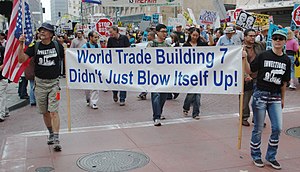
Apparently the official explanation is that WTC7 just blew itself up (Photo: Damon D’Amato)

I’ve said elsewhere, conspiracy theories seem to satisfy some of the same mental urges as religion. They are surprisingly like a mythos, in that they create exciting stories to explain the world about us. And just as religion, they provide the ultimate all-purpose explanation: Things difficult to explain can be seen instead as the manifestation of a powerful but invisible will. I’ll go out on a limb here and say that the idea of unseen will may actually be innate to the the human species, a built-in default hypothesis for about anything.

The thing making them different from religion though – or at least, traditional religion – is that the actors are not gods or spirits, but human. Still, perhaps conspiracy theories should be considered new materialist religions, belief systems for generations that, while still credulous, draw the line at the supernatural. (We’ll leave aside for now conspiracies that involve the influence of alien civilisations. These are supernatural beings in every sense that angels and demons are, just dressed from a contemporary costume box.)

But though the conspirators are not explicitly supernatural beings, they still have superhuman powers. They consistently pull off the scale of operation that non-clandestine organisations and governments usually seem to screw up. They have secrets that are never left in taxis or revealed by Wikileaks. They have superhuman powers of planning, efficiency, and organisation. Modern-day superpowers.

Hmm. They just don’t make gods like they used to.

Categories
Cosmography Politics

September 11 – The First Ten Years

wtc
View onto a lost world

Ten years ago I spent this day with an online community, riveted to the events of September 11 even as some of our members were living through them in New York. Many moving things were said. Many terrible too – naturally we had one or two who wanted vengeance equal in horror to the attack. One actually did use the term “carpet bomb them into the stone age”.

But that was overwhelmed by the nobility of what most had to say, even as their country was being attacked. And not just the things they said, but what they did. Phones were out in New York, and some were frustrated to the point of tears that they couldn’t let their families know they were all right. Then someone had an idea – the rest of us could make the calls for them. The community proved itself that day.

I hope they do not mind if, ten years on, I repeat some of their words here.

I’m sitting watching the sky get dark from the smoke of the third building collapsing, and seeing a layer of soot settling on the cars and sidewalks. Soot that might be skin and bone and hair and burnt fragments of family pictures.
I haven’t got to the anger and revenge part of the process yet. I’m thinking of the mommy and daddy who are right now dying under 110 stories of rubble, while their kids are waiting in some school cafeteria to be picked up.
And I’m buoyed by the simple acts of grace and humanity shown by most of the folks on this board, offering to make phone calls and expressing true concern.
Sleep and food don’t seem to be very necessary things. But solidarity and human-ness sure are.
Defending a home is as close to pure animal instinct as most civilized humans get, and that’s as it should be, I imagine.
But in the defense of principles, on the contrary, we must behave as principled people, we must act as rationally and intelligently as we have the capacity to muster.
I’ve spent the day in a lot of quiet thought and meditation, and in watching to be sure my friends and loved ones were safe. I don’t really have much to say about this, except that I hope that we do not inflame a larger conflict in our quest to bring the perpetrators to justice. That would be a far greater tragedy than a single bombing, however horrible.

Wise words, and prophetic.

Categories
Politics

Patriots And Paranoids

WTC antes9-11
They weren't much to look at but they were full of people

The 9/11 attack was brilliantly simple in its planning. All it required was a little organisation, and the mental capability to slaughter thousands of innocent strangers. Brilliantly successful too; its objective, to foster conflict between the West and Islam, seems to have been largely realised. Yet ten years on, a significant proportion of people insist on believing a far more complex explanation: That 9/11 was faked, not an attack but an inside job.

I say a significant proportion; it’s far from a majority, though any time at all spent on YouTube might persuade you otherwise. (One wide-ranging poll did find that less than half respondents thought that Islamists were responsible, but that survey included many people in Islamic countries naturally unwilling to be associated with the atrocity.) A 2007 Zogby poll (PDF) sponsored by conspiracy theorists themselves found that something approaching a quarter of Americans thought that elements within their government were complicit in the attack. This figure has probably dropped somewhat since Bush and Cheney left office peaceably, but there is still a sizeable minority – of Americans – who believe the US government was complicit in or even responsible for the most deadly attack on America in its history. Why?

I say ‘insist on believing’ because it takes an effort of will to decide that America was responsible for the attack on America. Even the ‘moderate’ version – that forces within the US government were merely complicit in the attack – asks us to believe that members of a Republican administration were willing to stand by and allow a devastatingly effective attack by genuine terrorists on the heart of America’s commercial interests, because they believed they could gain by it in some way. More ambitious theorists would have us believe that they blew the towers up with carefully set demolition charges, then flew planes full of passengers into them merely as a distraction.

Why do so many people, both Americans and their enemies, persist in this? Well, they have one telling thing in common: Both need to believe in the strength of America. For its enemies, the idea that a tiny terrorist outfit can wreak such destruction simply doesn’t fit with the image of a Great Satan.

By the same token, the Americans who think their own government destroyed the World Trade Center in order to make war and profit are patriots. They still believe that the one power on Earth capable of inflicting such terrible damage on the US could only be the US itself. These conspiracy theorists are not cynics. On the contrary, they have faith in America.

Categories
Politics

Democracy Is Over

OECD member states (as of 2006)
Organisation of Economically Crippled Democracies

So those young anarchist protesters ten years ago were right, globalisation did bring devastation and exploitation. Not to the Third World though. It actually turned out to be quite a treat for a lot of people there. In Europe and the US however, it has led pretty much directly to the collapse of democracy.

Globalisation has de-privileged the ordinary people of the West. And by the ordinary people, I mean anyone whose income derives from work rather than from ownership. Increasingly they find that they are in competition for employment not with the people of their own countries, or even with those of other Western countries, but all possible people.

In particular of course, people who aren’t the descendants of generations who fought for better working conditions, better wages, and democracy. Bluntly put, the work conditions and democratic freedoms enjoyed in the West were created when wealthy people needed a great deal of skilled and unskilled labour.

Conditions for the poorest improved suddenly and drastically at only two times during Western history. The first was after the Black Death. That decimated the peasant labourers, but it meant that afterwards there was a shortage of them. They could reject the previous conditions of their employment, which were more or less slavery, and start bargaining.

The second time was in the late 19th and early 20th centuries, when the Industrial Revolution created renewed demand for labour. Conditions in factories were of course horrific at the start when the supply of poor people exceeded the demand, but that turned around and labour was able to organise and gain much safer conditions and better wages. Ultimately, it gained political representation and universal suffrage.

Easing up conditions of trade with the rest of the world has completely undermined the position of the workforce – right up to the most skilled. Yet at the same time it has created new opportunities for business. With plunging labour costs, profitability has generally soared. But the tax base of most Western countries is not the wealth of business owners. To say the least, these are the people who can afford not to be taxed. They can afford the accountants. They can afford the lawmakers. So the tax base is collapsing. The countries of the West are simply running out of money, one after another.

But what can we do? It seems too late to introduce protectionism. The only option is to extract more money from the people who profited by exporting jobs – the corporations, and in particular the super-rich personally. But all the major political parties clearly do not dare to, they are helpless in the face of wealth.

Welcome back to serfdom.