Categories
Cosmography Humour Technology

Coffee Break

McCamridges2The window of McCambridge’s is one of the great places in Galway to have coffee. Looking onto the main shopping thoroughfare, it combines all that’s best about walking around town with all that’s best about sitting inside not doing that.

With our weather – and the last time I was here I watched a wooden forklift pallet being blown down the road – it’s a priceless resource.

The name of that thoroughfare by the way is Shop Street. I’ve always liked the excessive literalness of that. The adjoining High Street meanwhile is full of pubs. All we really need is for the banks to be down Arsehole Avenue.

But I must stop avoiding the issue, I’m here to apologise. This has been one of the longest breaks I’ve ever taken from writing here. What siren has lured me away with her haunted song? I’ll tell you honestly. Flagrant geekery. Part of the time it’s been Java. Not the coffee, the programming language. Part of the time it’s been Linux. All of it, in short,  stuff that most people neither understand nor – and here’s the really tricky part – particularly want to understand.

So writing about them in an entertaining way may be a little tricky. But  I will give it a  go.

Categories
Cosmography

Sun And Thorn

wpid-20130114_132759.jpg

Categories
Cosmography Humour Technology

Finally Fixing That Calendar

The phases of the moon: the golden part shows ...
An earlier, failed attempt at calendrical simplification

In many ways today is already the first day of a new year. Christmas is the de facto midwinter festival after all, and we’re already a week into the actual solar year. I wonder aloud, was December 25th chosen because it was the halfway point between the logical (but pagan-associated) solstice and the incorrect but well-established Roman new year?

So to start the year I will deal with some unfinished business. I’ve been promising to return to the topic of calendar reform since… January, gawd. As you’ll no doubt remember, I reached the conclusion that it would be nice if we could have one that keeps time with both the sun and the moon. The obvious problem here is that in reality, the periods of day, month and year just don’t divide into one another evenly. Why should they, after all? They’re just rocks spinning around in space.

The trick then is to find approximated versions of these periods that fit together neatly enough. Many civilisations have tried only to give up. Islam settled on a fully lunar calendar, which is why it is about 11 days shorter than the solar Christian one. That itself still has a vestigial lunar element; its months were originally in time with the moon, but various reforms have broken this almost beyond recognition.

Not though, beyond repair. They managed to square the solar cycle by adding an extra day every four years; we just need a similar idea to fix the months, so that the waxing and waning of one moon fits precisely into each. Because that would be cool. I put a lot of work into this, and figured out that it could be done quite easily. The real month is very close to being 29.5 days long, so we could simply have alternating calendar months of 29 and 30 days. No problem!

OK, months of that length don’t fit evenly into a year. There will be twelve and a bit between every winter solstice. But that’s the whole point – there aren’t an even twelve months in a real year, and trying to make it be that way has wrought a world where we all have to memorize a stupid rhyme. We just need to accept that and then we can move on.

But what we do want is for the months to stay, at least approximately, at the same time of the year; April will always be Spring, September Autumn, and so on. And as it turns out, just two “leap months” in every five years is sufficient to keep them aligned with better than 98% accuracy. Add a couple of minor rules and the cycles can be kept in time for thousands of years. I checked this out thoroughly, even using spreadsheets to painstakingly project the cycles centuries into the future. Incredibly, it stays in time. It seems almost too simple. Why had no one thought of this before?

Well of course, someone had – quite some time ago. After several days of calculations, I realised I’d basically just reinvented the Jewish calendar. It’s a fine piece of astronomical workmanship with roots going back to the very beginnings of civilization, and has been successfully keeping sun and moon in harmony for a very, very long time. Why don’t we use it, or something like it? I strongly suspect, simply because it is Jewish.

We should though.

Categories
Cosmography

A Christmas Tree In Sunlight

Christmas2012

Well you know, the exams. And then all the things I had to put off because of the exams. But it came together in the end. To be honest I was so hopped up on exam adrenaline that I got shopping done before I knew it. Oh and there was a side project – of which more anon.

Anyway, this year’s tree ended up being modest but respectable. Though I should point out that the picture shows a miniature pine, not giant presents. We got one in a pot as this is more eco-friendly, and also easier. Assuming it survives it’ll be brought in at Christmas for years to come. Biggest problem will be resisting the temptation to leave the lights on it.

Well I hope all of you who celebrate Christmas – whether you’re actually Christian, or merely see it as an opportunity to give things to people you care about – had a lovely day. I’m going to sleep now.

Categories
Cosmography Technology

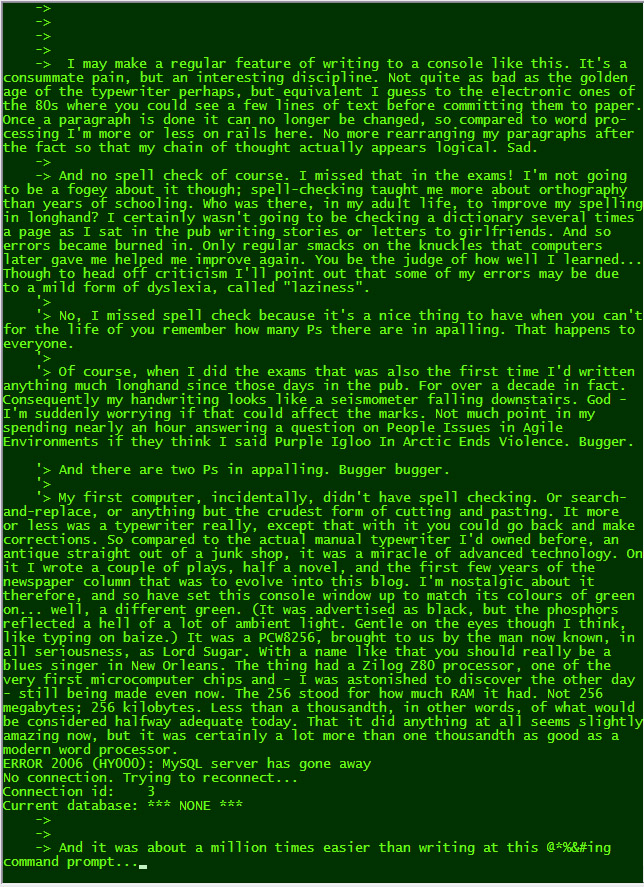
Console Of Philosophy 2

Console2

Categories
Cosmography Technology

The Console of Philosophy

Command Prompt 2

Categories
Cosmography

More Mystery Pictures

Well not so mysterious if you read yesterday’s post. Otherwise though, quite mysterious. Click them to view larger.

Categories
Cosmography Politics

Ireland's Abortion Law

Several people have asked me how our laws can directly contradict our own Supreme Court, which ruled that a pregnancy may be terminated when it threatens the woman’s life. How was this disconnect allowed to continue until somebody died? It’s not easy to explain, but I gave it my best shot.

It’s a constitutional impasse. The Supreme Court cannot force the introduction of a law, nor can it strike down existing legislation. It can only reject as unconstitutional bills referred to it by the President before signing. So the existing law – a blanket criminalization of abortion (for which the penalty is life imprisonment!) – stands, even if it is in conflict with the constitution.

The government has a clear duty to amend the law to reflect the Constitution – indeed, has had that clear duty for 20 years now – but legislature is meant to be the sovereign voice of the people so nothing has the power to force it to legislate, and neither major party wants to handle the political poison chalice of abortion. Even with the Catholic Church in general disrepute, religious observance at an all-time low, and polls showing strong support for abortion in some circumstances, framing the legislation would still spark huge ideological conflict in the conservative grassroots of both. And it takes a lot to shift the idea that abortion = killing BABIES, especially with religious right organizations able to wallpaper the country with pictures of cute foetuses at will. (They’re not short of funds, they have strong links with the religious right in the US.)

In 2010 however three women brought a case to the European Court Of Human Rights, which basically told the government that pretending a major women’s rights issue would just sort of somehow go away was not acceptable. And so it did what governments do – commissioned an inquiry to elect a commission to create a report, so weakening their identification with the eventual legislation, and of course delaying the fateful day a little longer.

A little too long for Savita Halappanavar.

The bitter irony for the religious right is that it’s the “Pro-life” amendment they campaigned for back in 1983, in the hope of keeping out a (then) rising tide of liberalism, that makes the antediluvian abortion law unconstitutional – because it describes an equal right to life for the woman¹. They didn’t want any woman’s right to be mentioned of course. They would probably have been happy with the innocent foetus having a prior right to existence over a necessarily sinful adult woman. Relatively sane legislators at least managed to insert this in the process of framing a constitutional amendment bill. But in a horrific case in 1992, the Supreme Court ruled that the suicidal feelings of a pregnant child rape victim constituted a threat to her life, so making that grounds for an abortion.

The religious right saw this as a potential – even deliberate – opening for abortion on demand. Now all a woman would need to do is say she felt a bit low and she’d get an abortion. So they actually campaigned to amend their amendment to explicitly discount suicide as a danger to the woman’s life.

Naturally the populace rejected this. We’ve heard about the judgement of Solomon.

When we rejected it, they tried to introduce it again. We rejected it again.

And you know what makes this all surreal and ridiculous? There is abortion available on demand in Ireland, and has been for decades. Not within Ireland, no. But a twenty minute plane ride away. You can go to Britain² or many other parts of the EU. I don’t claim this doesn’t put significant obstacles in the way, especially of poorer women, but thousands obtain terminations every year. Our bizarrely dated, draconian law prevents hardly any abortions at all.

Not that the religious right hasn’t tried to change this as well. When it was established that a woman in certain circumstances – i.e, she might die – was legally entitled to the abortion she couldn’t legally have here, they campaigned to prevent woman travelling abroad to have abortions, or obtaining information about abortion services in other countries. In a way it’s a shame they didn’t get their way. If women were being given ultrasound scans in the airports, if we had Internet filters to block sites that mention abortion, if adverts were cut out of papers and magazines, then their illiberal ideological madness would have been seen for what it was. We’d probably have abortion on demand here now. The ideological posturing survives because in reality it makes little difference.

Unless of course you are too sick to travel.

Sorry for that excursion through the history of nasty. We now reach the current situation, where things have been finessed with “guidelines” for medical practice – essentially, a life-saving medical procedure that inadvertently kills a foetus is not an abortion. Which seems all quite humane – until you have a situation like Savita Halappanavar’s, where terminating her pregnancy was not an operation necessary to save her life but merely one that would have reduced a hard-to-quantify risk to her life. Now I think a sane person would say that if the foetus cannot survive then there is zero conceptual, never mind moral, reason not to abort. Unfortunately the law as it stands was not created by any sane process.

But as luck would have it, the report I mentioned has just been completed and is about to be published – right into this storm of moral outrage. I am cautiously confident that things will change now.

²Or “the mother” as the amendment calls her, in some quite extraordinarily loaded language.
²Britain rather than the UK advisedly, as in a weird cross-border mirroring, abortion is also illegal in Northern Ireland. Presbyterians seem no more hot on women’s rights than Catholics.

Categories
Cosmography Politics

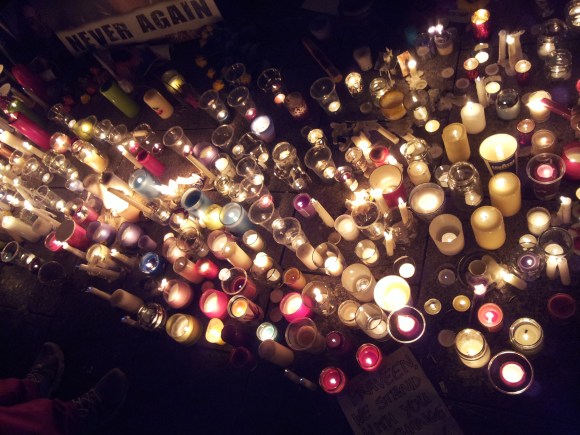
Galway's Vigil for Savita

This evening I stood for an hour in Eyre Square Galway thinking of Savita Halappanavar, an Indian-born dentist who died in hospital here. While investigations are ongoing, it appears that she was refused the termination of an already miscarried pregnancy, a procedure that might have saved her life. There seems little room for doubt that this was an avoidable tragedy caused by our wholly inadequate laws.

This is the hospital I go to when I get sick. Where my mother gets regular check-ups. Where my father was pronounced dead. It is the hospital attached to the University where I study science now, where I once took courses in women’s rights. I’ve always had confidence in it and its staff. But they made decisions here that were not based on medicine, but on a certain doctrinal viewpoint. That is wrong.

If they made an immoral choice though, they made it under the threat of an immoral law. Or we should say an immoral absence of law, thanks to one political leadership after another running scared from its duty to enact legislation clarifying this issue, and despite a Supreme Court judgement that found a blanket ban on abortion unconstitutional twenty years ago.

So what is the legal position on medical abortion in Ireland? Frankly your guess is as good as mine. According to the Constitution:

The State acknowledges the right to life of the unborn and, with due regard to the equal right to life of the mother, guarantees in its laws to respect, and, as far as practicable, by its laws to defend and vindicate that right.

This seems to suggest that there are circumstances in which a pregnancy can be terminated in order to save a woman’s life, and in practice this can happen. An ectopic pregnancy – the condition where the embryo implants and begins to develop outside the uterus – will be removed without compunction. It would be monstrous to give an embryo which could never survive the same rights as the woman it would inevitably kill.

And yet Savita’s foetus had no hope of survival and the threat to her life, while not certain, was severe. Why was a non-viable pregnancy allowed to cause her unimaginable distress leading almost certainly to her death – were they hoping a miracle would somehow save its life?

No. They did not terminate the pregnancy because they didn’t consider they had the right to. The foetus was a person with an inviolable right to life, so the fact that it was going to die was not morally relevant; you can’t kill people just because they’re going to die soon anyway. Only in circumstances where it was absolutely certain that the continuation of the pregnancy would lead to the woman’s death could they have moved to end it, and outside clear-cut cases like ectopic pregnancy such certainty is of course rare.

So they went instead with the moral – but wholly fictitious – certainty that the foetus was a human being with a right to life that must be respected, and Savita Halappanavar died.

The idea that human life begins at conception is not a scientific fact. Nor is it ancient knowledge – conception was only understood fairly recently. It is a doctrine. We might as easily consider human life to begin with the first breath. (Indeed that used to be the belief.) We might consider that it begins at some point between conception and birth, even that it begins before conception in some spiritual realm. But a foetus is not a baby any more than the separate sperm and ovum is, and to treat it like one is just a doctrinal fantasy. Enforcing that fantasy on real people can only lead to tragedy.

Categories
Cosmography Politics

The Price Of Victory

Think of it as the world’s worst industrial accident

It’s a little weird if you tune into a British TV show around this time. Everyone is wearing red paper poppies in commemoration of soldiers killed by wars in general, and what is still sometimes called the Great War in particular. Strange, not just because they happen to be fighting one even as they mourn the tragedy of it all, but because debate rages over this conflict even today. Was it, as some argue, a stupid and pointless waste of human lives? Or as others say, an utterly mindless massacre of innocent people? We may never know for sure.

There really have been attempts recently to rehabilitate this war. It was once common to explain it as a tragic chain of circumstances. Surely such a terrible tragedy could only have been unintentional.

But it is becoming more common now to hear that, far from being accidental or tragic, it was a necessary and even heroic action to curtail the ambition of a warmongering Kaiser Wilhelm II of Germany. Is that true? It certainly is a more positive way to see it.

The only problem is, it differs from the British propaganda of the time in almost no respect.

Yes, Germany had been getting more belligerent. Wilhelm was indeed a war-happy idiot, childishly envious of his cousin’s ships. His empire had been growing in wealth and strength rapidly since its formation nearly half a century before, and was eager for opportunities to flex its muscles. That opportunity came with what might otherwise have been a local Balkan conflict, as the Austro-Hungarian and Russian empires scrambled for the territory of the (even more) moribund Ottoman one. Turning it into a Europe-wide conflict gave Germany a chance to elbow aside France and dominate the continent.

True enough. The only problem with this narrative is that the British in their turn were only too happy to escalate a European conflict into the first ever global war.

Having pioneered industrial manufacturing Britain was still the greatest power on Earth. It had however watched the rise of German industry, technology, and military might with trepidation. The imitator looked like it would one day outstrip the master. An arms race had being going on for over a decade and some believed that war with Germany was inevitable – and that therefore the sensible (if Machiavellian) choice would be to have one sooner rather than later. This is really the only way to explain why the largest empire in the world went to war over the invasion of Belgium. I mean think about it. They couldn’t have liked chocolate that much. Britain was eager for war. We often hear that they kept saying it would “all be over by Christmas”. What we forget is that they said this because they liked to think of the Germans as a bunch of primitives they could crush without much effort.

Without the entrance of history’s largest empire into the conflict, what would have happened? We can never know of course – hell, we can barely know things in the past that did happen, never mind ones that didn’t – but it seems more likely at least that France would’ve fallen and Germany would have been able to concentrate on a war with Russia that might have continued for years. I’m not sure if it’s even technically possible to defeat Russia. How would you know you had?

But eventually Germany probably would have gained hegemony in continental Europe. Big deal. And without its population devastated, Britain would have continued as a global power for much longer. The Russian revolution wouldn’t have happened, the US wouldn’t have had its first taste of global military intervention – or experienced the boom that turned into the Great Depression either. The conditions that gave rise to the Second World War would never have been in place. And of course, millions fewer would have died.

I think there are a couple or lessons here. One is that war is always inevitable if you want it to be. The other is that, it tending to have vast and profoundly unpredictable consequences, it might be better to hold off on war until you really do have no other choice. But that wouldn’t be a welcome message just now.