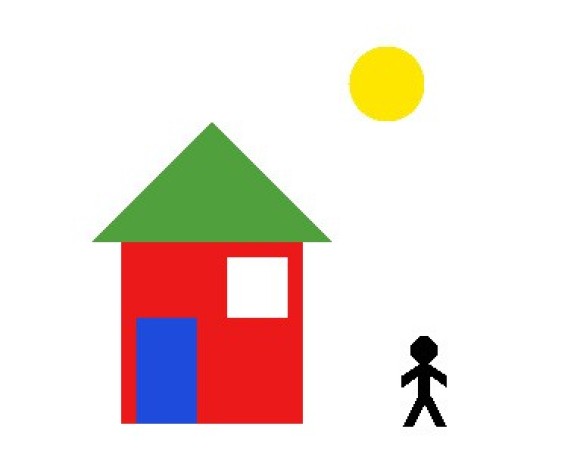
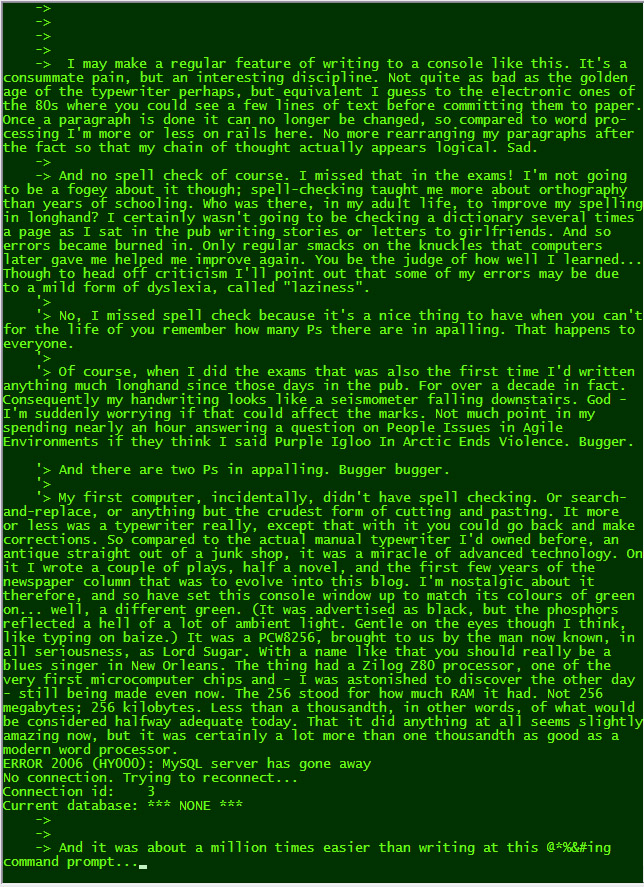
Seriously, we did this in class. OK, a lecture. It brought me back to a very different, though in some ways surprisingly similar, but mostly different school I went to many years ago.
I drew a house there too, maybe on my very first day. It’s certainly one of the first things I remember. I distinctly recall having trouble making the place I finished drawing the roof be the same as the place I started. Triangles are the hardest basic shape.
I recall my contempt for the children who drew their square windows in the very corners of their square house. Imagine that! Had they no powers of observation? Obviously the windows should be a little bit in from the corners. I mean, otherwise you’d see the edges of the side walls through the glass. Sheesh.
The biggest difference is that I drew that house with a pencil. Today in school we drew houses with the Java programming language. It’s harder, drawing your house with the Java programming language. For example, at the age of four I didn’t spend a weekend staring at my pencil and paper going “How the **** is this supposed to work?”
So you’re seeing here the first thing I ever made in Java. I really do feel a little like a small child in school again. At the end of the class I printed it out and gave it to the teacher.
There’s nothing wrong with horse meat. Horses are healthy, clean, athletic, and mad. Their flesh is low in fat and full of flavour – rather like Labrador. No, the problem is not with horses per se. There are other, quite valid, reasons to object to this animal turning up unexpectedly in your burger.
The first of course is that an animal has turned up unexpectedly in your burger. It’s more than a bit disconcerting. And, disrespectful. If a waiter brought you something you didn’t order and when you objected told you it didn’t actually matter what you ate, you’d be annoyed. We want to know what we’re putting in our mouths. To an extent I mean. We’re all aware that sausages are made out of eyelashes and earwax, but we’re prepared for that. Beef – or ‘beef’ – we at least expect to be made out of cows’ eyelashes and earwax.
And then there’s this worry: Remember bovine brain and spine matter. How can we feel sure they’re successfully keeping that out if entire horses can slip in? It’s an awful thing for the image of the food industry. Now probably it’s perfectly good terribly bad meat, sourced on the continent as a legal, safe, and seriously cheap filler ingredient for barely-edible bargain burgers. It’s just that somewhere along the way someone missed a memo about what is considered a food in some markets and a friend in others.
So I think it shouldn’t be destroyed. I’d eat it. Once they test it for everything from BSE to cat AIDS, I’d eat it. Whatever about the morality of meat, it’s clearly immoral to kill something and then refuse to eat it – not to mention rude. And as meat in itself is incredibly wasteful – the same amount of land feeds around twenty times as many people on a vegetable diet – it’s just stupendously wasteful to waste meat.
Or well, waste hair follicles and mechanically recovered connective tissue.
To build a good system cheaply, you need the help of a friend: Sheer damn luck. You’re going to have to find bargains.
But this is the sort of luck that only happens when you’re ready for it. You can’t get good deals until you know exactly what you’re looking for, so the magical serendipity comes only after the painstaking research.
This article aims to save you some of that. To start with the basics then, the minimum you’ll need for a PC is:
Video card is in brackets because many motherboards and processors have video built in. You have the option of adding one (or more) for demanding tasks like gaming.
Similarly, audio and wired networking usually come integrated these days. (Be aware though that Wi-Fi isn’t so common.) You may notice I’ve left out speakers, on the basis that they’re not strictly necessary – and of course there’s a good chance you’ll have passable speakers or at least headphones lying around somewhere. Can we cut the bill down still further? Well, you may be able to do without the monitor. If your motherboard or video card has an HDMI output you can probably plug it straight into your new flat panel digital TV. And if you happen to have a portable USB DVD drive, that should do the job fine. (And arguably is a better investment than a built-in one, which these days is going to spend most of its time idle.) If you want you can add these pieces, and much more besides, as and when you have the money. This expandability is the nicest aspect of the PC architecture, and it’s worth exploiting while it’s still here to be enjoyed.
It is essential therefore to begin by planning for the future. You’re building a good-but-inexpensive system now with a view to transforming it into an amazing-but-still-not-too-expensive system over time, so you need to start out on the right track. There’s no point in saving money on say a cheap motherboard if the memory it takes won’t be made any more. A component is no bargain if it’s only compatible with others that are expensive, and to an extent every component of a PC is dependent on, and so must be compatible with, every single other.
Odd as it may seem, I don’t own a good computer. There are maybe a dozen of the things strewn about the place, in various states of obsolescence and/or disassembly. Some are essentially museum pieces now – an Amstrad, a Psion Organiser. Others were never new, but cobbled together from discarded parts. Even the best have long reached the limits of their upgrade potential, and show their age when threatened with recent software.
Considering that I’m doing a degree in information technology, this borders on the embarrassing.
My new year project then is to create a computer that is truly… good. Not only powerful by the standards of today, but with a potential for upgradability that will keep it current for years. What’s more, if I’m going to build a computer from scratch by hand I want it to be a piece of workmanship, satisfying both technologically and aesthetically. So the choice of components will be critical.
Only one small obstacle: I’m almost completely broke. An excellent computer then, at a bargain POS price.
I was doing an electronics job, replacing the LNB on a satellite dish. That’s the receiver bit at the focus there; it’s much more than just an antenna though. Controlled by the set-top box, the LNB is actually re-tuned to the particular frequency you’re looking for. The microwave signals are too tenuous to bring down a wire to a tuner, so it has to be done right here. Which is why you can’t watch one satellite channel while recording another, and have to find something on RTÉ to watch instead.
Before I understood this I’d tried to split the signal from a dish into two boxes, with predictably unpredictable results. What you need is an LNB that has multiple outputs. Here we went with four, so you can record two satellite channels while watching two others. Say.
A word of warning if you’re considering doing this – I got the LNB in Maplin. Don’t do that. Maplin are well known to be on the pricey side for some things, but in the case of the LNB I paid at least double what I could’ve got this for online. They provide a great service and I like to patronise them, but that’s a bit much.
Especially as it wouldn’t fit. The current LNB (pictured) has an integral bracket, The new one doesn’t, so I had to go back for one. Also – now that I’d actually done research – some silicone grease and self-amalgamating tape. The former is a jelly-like waterproofing agent in a tube, the latter a strange sort of rubbery tape that melds with itself to make seals for the cable connections. And if the LNB was overpriced, these accessories were eye-watering. The bracket, a small piece of plastic that bends into shape, fetched €16.49. Here’s the same thing for a fiver. The job could have been done for half nothing with a little planning.
But anyway, armed with all the right bits today I climbed the ladder, undid the cable and pulled off the old LNB, pushed in the new one with its bracket, did up the cable, came inside and turned on the TV. And this is where the weird thing happened.
It worked first time. No hitches, no inexplicable problems, no wasted hours figuring out what I did wrong. Swap the units over… TV pictures. I didn’t have to alter the positioning of the LNB, futz with its polarisation angle, re-scan the channels, nothin’. The job was just done.
An earlier, failed attempt at calendrical simplification
In many ways today is already the first day of a new year. Christmas is the de facto midwinter festival after all, and we’re already a week into the actual solar year. I wonder aloud, was December 25th chosen because it was the halfway point between the logical (but pagan-associated) solstice and the incorrect but well-established Roman new year?
So to start the year I will deal with some unfinished business. I’ve been promising to return to the topic of calendar reform since… January, gawd. As you’ll no doubt remember, I reached the conclusion that it would be nice if we could have one that keeps time with both the sun and the moon. The obvious problem here is that in reality, the periods of day, month and year just don’t divide into one another evenly. Why should they, after all? They’re just rocks spinning around in space.
The trick then is to find approximated versions of these periods that fit together neatly enough. Many civilisations have tried only to give up. Islam settled on a fully lunar calendar, which is why it is about 11 days shorter than the solar Christian one. That itself still has a vestigial lunar element; its months were originally in time with the moon, but various reforms have broken this almost beyond recognition.
Not though, beyond repair. They managed to square the solar cycle by adding an extra day every four years; we just need a similar idea to fix the months, so that the waxing and waning of one moon fits precisely into each. Because that would be cool. I put a lot of work into this, and figured out that it could be done quite easily. The real month is very close to being 29.5 days long, so we could simply have alternating calendar months of 29 and 30 days. No problem!
OK, months of that length don’t fit evenly into a year. There will be twelve and a bit between every winter solstice. But that’s the whole point – there aren’t an even twelve months in a real year, and trying to make it be that way has wrought a world where we all have to memorize a stupid rhyme. We just need to accept that and then we can move on.
But what we do want is for the months to stay, at least approximately, at the same time of the year; April will always be Spring, September Autumn, and so on. And as it turns out, just two “leap months” in every five years is sufficient to keep them aligned with better than 98% accuracy. Add a couple of minor rules and the cycles can be kept in time for thousands of years. I checked this out thoroughly, even using spreadsheets to painstakingly project the cycles centuries into the future. Incredibly, it stays in time. It seems almost too simple. Why had no one thought of this before?
Well of course, someone had – quite some time ago. After several days of calculations, I realised I’d basically just reinvented the Jewish calendar. It’s a fine piece of astronomical workmanship with roots going back to the very beginnings of civilization, and has been successfully keeping sun and moon in harmony for a very, very long time. Why don’t we use it, or something like it? I strongly suspect, simply because it is Jewish.
Well you know, the exams. And then all the things I had to put off because of the exams. But it came together in the end. To be honest I was so hopped up on exam adrenaline that I got shopping done before I knew it. Oh and there was a side project – of which more anon.
Anyway, this year’s tree ended up being modest but respectable. Though I should point out that the picture shows a miniature pine, not giant presents. We got one in a pot as this is more eco-friendly, and also easier. Assuming it survives it’ll be brought in at Christmas for years to come. Biggest problem will be resisting the temptation to leave the lights on it.
Well I hope all of you who celebrate Christmas – whether you’re actually Christian, or merely see it as an opportunity to give things to people you care about – had a lovely day. I’m going to sleep now.