Categories
Technology

Reading At Night By Invisible Light

By (Hgrobe 06:16, 26 April 2006 (UTC)) - credit: Hannes Grobe/AWI - Own work, CC BY-SA 2.5, https://commons.wikimedia.org/w/index.php?curid=567773

Among the more pointless things I’ve done recently is install a blacklight CFL in my bedside lamp. This is to encourage me to take up reading books again. Do you follow? It’s a simple idea really. I’ve grown so used in the last decade or so to reading from screens that paper seems a bit weird now. But turn on a UV lamp and what happens to a book? It glows. Like a screen!

Bleaching agents in the paper must make it fluoresce. Not all the fibres seem to have it equally though, and the page takes on an oddly speckled, grainy look. It is bright enough to read by though, just about.

All right to be honest this isn’t really why I got the bulb. I bought it because I’d never seen a blacklight CFL before, it wasn’t expensive, and I thought it was too interesting not to buy. In action it seems more violet than invisible, but white things around the room glow in an eerie way. The shirts I have hanging look particularly fierce, and the pale neon emanating from my map of Europe hints at the trippy possibilities. This all gives the room an… interesting look – somewhere between clinical laboratory and tatty ghost train.

And I notice that it actually makes the photochromic lenses of my glasses go dark, so it really does seem to put out a healthy (?) amount of ultraviolet light. Perhaps if I sleep with it on I’ll get a tan this summer.

Categories
Cosmography

Rabbit In The Garden

Rabbit1

Rabbit3

Rabbit2

Few things more lovely than looking out a window and seeing a wild animal obliviously eating the garden. At first I thought it was a young hare, as that’s the lagomorph you get most often around my mother’s place. But somehow there’s an unmistakable cuteness about rabbits; they’re to hares as Spaniels are to Great Danes.

Pictures aren’t great I’m afraid. Pushing the poor Note’s camera well beyond its designed limits again. Obviously I was nowhere as close to this nervous wild animal as it looks. These were taken through double glazing from 10 metres away.

Categories
Cosmography

Wasp Macros

Some more photographs of our mystery bee-wasp, which I think will clinch its species. The puzzle only really begins there however.

Here from the back, it’s difficult to distinguish Hasdrubal from a honeybee. With her deep brown abdomen you can only just make out the wasp markings. Lookit her little stinger! You can hardly see that with the naked eye. Which is perhaps as well considering how much I had to handle her.

BeeWaspBack

Sorry about the soft focus incidentally, this was really pushing the Note’s 8Mpx camera to its limits. Though I have to admit it’s not technically impossible to take sharp close-up pictures with it, merely humanly difficult. Depth of field becomes negligible while shake is amplified.

From the front it’s a different story, there’s zero doubt that this is a wasp. The face is absolutely typical. As are the antennae and slender legs.

And, incidentally, the hair. In my mind wasps are as smooth as spray-painted steel, but this research has shown me that they’re really quite fuzzy. I guess it’s the (normal) black-and-yellow markings; nature’s alarm signal makes you oblivious to a wasp’s cuddlier aspects. Or at least keeps you too far away.

We also see where H.R. Giger got a lot of his inspiration. Brr.

BeeWaspFront

What species of wasp though? Thanks to Bruce Ruston of Blue Platypi Photography who sent a link to this great wasp ID chart, I’m almost certain that Hasdrubal is a common wasp. She has the distinctive “anchor” on her face. The only other variety that looks a lot like this is the red wasp, but its thorax markings are quite different – as we see in the shot below.

BeeWaspBack2

So Hasdrubal is almost certainly a common wasp – except she’s simply the wrong colour. The question then is whether this falls within the normal variation of the species, or if she’s some sort of freaky mutant.

That it’s possible to get tolerably sharp macro shots with this camera is demonstrated by this final one, in which I thought to ask Hasdrubal herself what sort of hymenoptera she is.

BeeWaspMacro

Categories
Cosmography

Bee-Coloured Wasp

Any entomologists in? I came across a curious thing. The rest of you, don’t scroll down if close-up pictures of stingy insects disturb you. Or indeed offend you – it is naked after all. And dead. I really wouldn’t look.

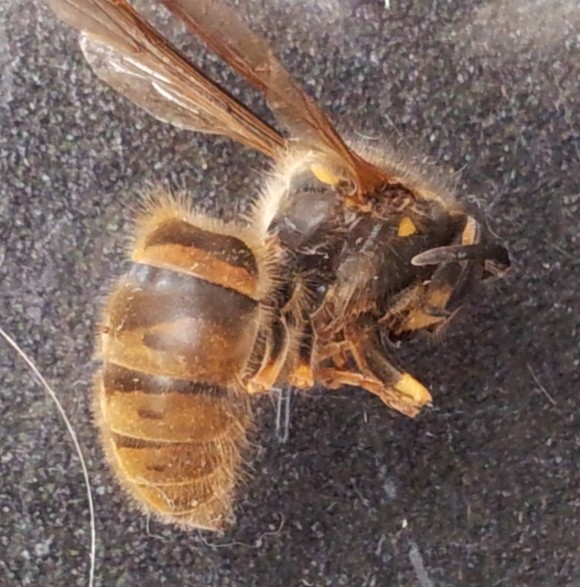
OK now the wusses are gone, what do you think is going on here? It’s a wasp, coloured like a bee. Definitely vespine in its shape and features, with the pronounced segmentation and aggressive I-am-nature’s-attack-helicopter angles. But instead of the usual biohazard yellow it has the warm goldie-browns of a honeybee.

Well, makes a change from all the cartoons you see of bees coloured like wasps.

I don’t have a camera for macro photographs, but got surprisingly good results with the phone. The problems were holding it steady and getting the background right. In the end I put it in a glass jug; this gave me something to rest the phone on and allowed me to shoot over different surfaces. As the phone compensates to keep an average brightness, the creature looks a lot brighter when shot against a dark background. (I could’ve tried different camera apps that allow you to meter light more precisely, but this was quicker.) In the first one here therefore it actually looks a lot more yellow than it really is, and so more like an ordinary wasp. But it brings out the detail well.

Hasrubal The Bee-Coloured Wasp

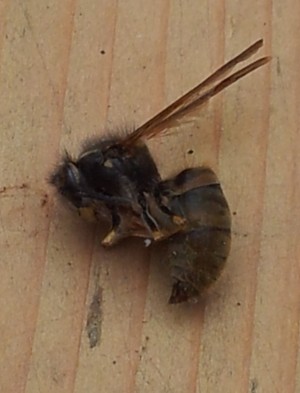
20130616_153643White backgrounds on the other hand make Hasdrubal – I call her Hasdrubal, for reasons which remain unclear to me – look virtually black. The woodgrain one to the right (taken without benefit of the jug) probably gives the best impression of how she appears to the naked eye. If anything, a little darker than a honeybee – but with similar golden hair.

Which is the odd thing. Whoever heard of a hairy wasp? Bees wear a fluffy bolero but wasps, so far as I’ve noted, are shiny-shaven. As you can see, particularly in the first pic, this one has no end of fuzz. I can find no species that fits the description. The European Hornet is a little hairy, but a lot more wasp-coloured. A mutant? Diseased? I have no idea.

I hope someone does.


Categories
Humour

More Adventures in Furniture

DrawersJust got a bedside chest of drawers from B&Q. It came as a flat-pack, which pleased me no end of course. A kit! I loved those when I was about twelve. It would be just like making a model aircraft again – albeit one with unusually poor aerodynamics.

Well no, as it turned out. Not really. The difference is that with a model, at least half of what you’re paying for is the process. Owning a plastic plane is as nothing compared to seeing it materialise beneath your hands. With flat-pack furniture though, you’re paying for furniture. Very few people , you’ll notice, spend their evenings building model wardrobes.

The assembly is not a thrill, but something you do to save money. At least that’s the theory. This thing cost nearly €100, which seemed like a reasonable price when displayed on an example of the finished object. After making it myself, I reckoned €100 was roughly what B&Q owed me. This was several hours of not wholly unskilled labour, and frankly a small wooden box seemed insufficient reward. Five different sizes of screw, plus assorted bolts, plugs and nails. Three sliding draws on metal runners. Twenty-three variously shaped pieces of timber. While it’s true that when I was a child the best model was the one with the greatest number of interesting parts, this is not a sought-after quality in furnishings.

And I got a splinter.

The parts are of reasonably good quality. Light yet solid pine stained to look like a more expensive tree, but no tacky plastic or MDF. It all fit together nicely, and the results felt solid – or at least they did when I added a few nails and doubled down on the amount of woodglue it came with. (In particular, using it to help keep the handles in place. Knobs that screw on, screw off.) The problem was that the instructions were way less helpful than they could have been.

The thing is full of screw holes that go unused – presumably the same bits make many different pieces – but you absolutely must use the correct ones, which makes assembly far more fiddly and the risk of error far higher than it really needs to be. And while the diagrams are never actually wrong, they could be a whole hell of a lot clearer. Much time will be wasted glaring at the pictures in an effort to ascertain exactly which of seven closely-clumped holes is being indicated – or alternatively, on the non-amusing task of taking it apart and putting it back together right. They’re often the butt of jokes, but IKEA‘s instructions are a model of clarity compared to B&Q’s Danish imposter.

Still, you end up with an almost entirely style-free but not unattractive piece or furniture. Whenever I look at it – which should be most days as I’m keeping my socks in it – I’ll be able to say “I made that, with my very own two hands, the day I was held captive and forced to work by that chain of British hardware stores”.

Categories
Cosmography

The Mystery Of Summer

20130605_174156
Something isn’t right about this picture. The colour of the sky looks wrong. Too… pleasant.

You won’t believe what I’ve just been doing. Watering a garden! With a hosepipe yet. It must be four or five years since I last needed to do that. It may be too soon to interpret this as the end of our appalling run of summers, but it’s a great feeling.

Sunny Ireland. Seems almost an oxymoron, like quantum vacuum or a healthy treat. The first real summer days seemed evanescent, illusory. As if the fates were teasing and testing, daring us to bare the vulnerability of hope. Then as soon as you accept it’s true, you find yourself wondering if this is what you really wanted. It’s not easy to get used to heat after so long. It is… hot. Not just warm and cosy, hot. And bright. It makes you sore. I’m sitting inside now, itching mildly all over, glowing pink as a neon sign. You know when you’ve been irradiated.

It’s amazing how much there is to be done outdoors, now that it’s possible to go there. I have spent much of today destroying the unapproved plants and planting the approved. A border of verbena and ageratum, should be very pretty. Repairing the lawn – a cow had strayed into the garden and been chased around a bit. She must’ve been big, her hoof prints were inches deep. Tying up climbing plants, spreading grass food, cleaning paint brushes, and now of course this watering. So much done today.

And yet, I feel unworthy of sleep. I got almost no JavaScript studied, I’ve yet to even begin work on that old range, I’ve a client in Australia I promised to get back to about a sale, I’ve made really little progress with the design of a new website, I still haven’t… written this yet.

You know, what I need to do is pay someone to come around about midnight and just hit me over the head.

Categories
Politics

Cognitive Dissidence

365px-International_Monetary_Fund_logo.svgIreland is the success story of austerity, the figures prove it. According to the IMF, the domestic economy grew 2.38% over 2010-2012. The bitter medicine is working. Soon we’ll be able to borrow on the markets again.

Yay.

But even the IMF admits it got it wrong in Greece. Severe austerity there has only deepened recession and dashed any hope of quick recovery. Yet somehow the very same policy seems to have worked in Ireland. Mysterious.

Hold on. Is this not the same Ireland that was recently called a tax haven in the US Congress? A country that – there is no secret to this – encourages transnational corporations to declare their profits here instead of in

other, higher-taxing jurisdictions. How much of our apparent growth, touted by our EU partners as the fruit of prudent austerity, is actually owed to what we might call the Tourism For Your Taxes sector?

Every damn bit of it.

Discounting the money-shuffling activities of transnationals, the domestic economy in Ireland declined by 5.2% between 2010 and 2012 (Source: Dr. Constantin Gurdgiev). The real economy – the one in which people who actually live here have to work and buy things and pay their (much higher) taxes – is one of closing businesses, joblessness, emigration, debt. Austerity as it actually works.

This presents an interesting conundrum for our EU partners. They wish both to use us as proof that austerity works, and to condemn taxation practices that are patently ripping them off, all the while maintaining the cognitive dissonance necessary to avoid acknowledging a causal connection.

Good luck with that, partners.

Categories
Cosmography

Varnishing Point

Washstand
It looks just like this. Well it will when I’m finished. Or would if I knew what I was doing.

I’ve taken up paint stripping. That’s where you cover yourself in several coats of gloss and dance around on stage with a scraper. No it isn’t.

There was this old washstand hanging around my mother’s house, lookin’ ugly. I’d never restored furniture before, but I was varnishing the window frames and thought “Well it’s much the same job, may as well do this while I’m at it.”

The windows were finished a week ago.

They were nice fresh cedar wood, not caked in ancient brown paint. Actually I mistyped that as “cacked” first and it was better. This table was totally cacked in brown paint. A rub of sandpaper was not going to bring about meaningful change.

So I got me some Nitromors, the popular paint stripper, slapped on the whole tin, gave it time to do its chemical stuff, and went at it with a scraper. I might as well have attacked it with a sandwich.

Am TipÂą: If you’re using Nitromors on an encrusted piece like this, don’t get the “Craftsman’s” variant. No matter how art-and-crafty you’re feeling, use “All purpose”. It’s more powerful, it’s thicker, and it’s whitish instead of clear so you can actually tell where you’ve put it.

Also the scraper I was using flexed far too much for the job. In the end I got two – a multi-purpose painter’s tool that looks like a miniature seaxe, and the even more ferocious shave hook. Now this really was the business. Its one drawback: with its multiplicity of pointy ends it’s easy to damage the wood with it. Or yourself. Or passers-by.

But with it and the new stripper the paint finally began to move. About three layers down I find one of duck-egg blue. My first reaction – who the hell paints a piece of wooden furniture duck-egg blue? My second though was one of admiration. People who have duck-egg blue paint and just don’t care, that’s who. People with a fine disregard for conventions, appearances, notions of taste.

My third was “Glad I have varnish”.

So the chemicals and violence got the worst of it off, but left a sort of muddy patina. Next then, the scratchening; I dug out the old sanding attachment for the drill. Judging by the dearth of compatible discs in the hardware store this is pretty much an antique now, ousted by dedicated disc and belt sanders, but the drill attachment works well enough. Too well at times; while I was still getting the hang of it I managed to scoop huge depressions into the wood. Pretty lucky I’d started on the underside.

But though this does get you down to the grain with a pleasing speed, it’s only much use on flat areas – of which the washstand has few. The turned legs and grooved details will all have to be done by hand. Lord this is going to be a job. Pictures when it’s done.

ÂąLike a Pro Tip, except from someone who doesn’t know what the hell they’re doing.

Categories
Cosmography Technology

A Ball Of Blue Flame

English: 42, The Answer to the Ultimate Questi...

I didn’t speak before now about my last exam. The thing is, I’m really not sure how I did.

It felt good. I left the exam hall exhausted, elated, as if I’d given my all.

I just wish I could be sure that my all is the all they wanted.

I have no complaints about the paper. Couldn’t really have been better from my point of view. I was able to avoid the cost analysis question I dearly wanted not to do. It wasn’t a hard one; basically it’s just a sum. The problem was those two words – “cost analysis”. I had to stay alert through a whole exam, and just looking at them makes my eyelids droop.

The systems theory question on the other hand was all too exciting. Yes, seriously. It involved concepts that have interested me for a long time. Visualising the world not as discrete objects but in terms of interacting systems, flows of activity and information. Emergent phenomena – how all the complexity and wonder of life arises out of apparently simple chemistry, or indeed solid matter out of ephemeral probability. The danger with this was that I could easily blow the entire two and a half hours if I got hooked on a wild-eyed Idea.

So I began with the case study question, which retrod a lot of ground we’d covered in our projects. This made it easier, but had the downside that my head was preloaded with too many things I could say. And I think I said too many of them, because I spent over an hour on that one.

Thankfully, next was what’s known as a decision table. These distil a complex decision-making process into a simple table you can look up. You might – as in the example – be a college book shop trying to decide whether to keep some old titles in stock or return them to the publisher. There are a bunch of factors involved, how do you decide? Well here the table shows that if, for example, an edition is no longer current. but has been requested by staff, then the correct response is to keep it. Simplicissimo.

Condition USER RULES
1 2 3 4 5 6 7 8 9 10
Edition Is Still Current N N N Y Y Y Y Y Y Y
Old Edition Requested By Academic Staff N N Y
Any Copies Sold In Last 3 Months N N Y Y Y Y Y
More Than 15% Of Stock Sold In Last 3 Months N N Y Y Y
More Than 20% Of Stock Sold By Mid-Semester Y N N
Sales Manager Believes Book Will Still Sell N Y N Y N Y N Y
Action
Return Remaining Stock X X X
Consider Returning 75% of Remaining Stock X
Keep Remaining Stock X X X X X X

Why is the table so small? Having six conditions, each with two possible values – Yes and No – you’d think it would need (2x2x2x2x2x2=) 64 columns instead of 10. The trick is that some conditions make others redundant. Look at what happens if the Sales Manager decides a book will still sell. Their word goes, making all other considerations moot. By examining the logic in this way you can reduce the table to its essentials.

The problem then is making sure you’ve done it right. Do the rules really cover all possible situations? Could two different, contradictory actions be invoked by the same set of conditions? That latter is particularly significant because tables like these form the basis of computer programs, and when a computer is stuck between two conflicting responses it explodes.

Possibly.

Examining a table for logical consistency sounds scary, but when you boil it down it’s a puzzle not unlike a Sudoku. Having practised, I’d got the knack of solving them visually. Well, simple ones… That saved time which by now I badly needed. I’d left myself barely more than half an hour for all the theory. Things were now officially intense.

So I don’t recall clearly what I wrote… I do know though that somehow I got stuck on aspects of systems theory that bug me. Couldn’t I write a happy answer about the many aspects that I think are cool and interesting? No, apparently I can’t do that.

Really it was one particular lecture slide I was hung up on. This had compared science to the systems approach, contrasting them as analytical versus holistic, qualitative versus quantitative, so on. In other words presenting the systems approach as a counterbalance, even an alternative, to science. That struck me as just wrong; overshooting the holistic and heading into homoeopathic country. Or “needlessly messianic”, as I described it. (Which incidentally was the second entirely pointless Hitch Hikers Guide to the Galaxy reference I found myself slipping into these exams.)

In particular it described science as “reductionist”, which to me is to misunderstand it completely. Sure, science takes things apart and examines the components. But it doesn’t do that to understand the components; rather the objective is to see how they all work together – as a system. As a whole.

Holism is right there in science. To claim otherwise is to traduce humanity’s most important philosophical tool for one’s own obscure – or obscurantist – motives.

OK I didn’t say that last sentence, thank God. I was having a bit of a head rush but I still knew better than to condemn the subject I was being examined in as an evil conspiracy. I’m not doing English lit any more. And I don’t think that of course. What I hope I managed to convey is that I find systems theory attractive, but at the same time worry that this very attractiveness may make it dangerous. Is it a useful way of looking at the world, or a friend to fuzzy thinking? Well, I’m not sure – but I want it to be useful.

Maybe my suspicions were refreshing, maybe I’ll be marked down for insufficient imbibing of the Kool-Aid. In short, yet again I am certain that I either (a) did a really good exam or (b) plunged off the cliff in a ball of blue flame. One or the other.

At least it’s not dull.

Categories
Politics Technology

Should Apple & Google Pay More Tax In Ireland?

Apple I at the Smithsonian Museum
As far as we can ascertain, this is all Apple actually made in Ireland

No.

OK maybe I should expand on that a little.

Hell No.

All right, let’s break it down: Should Apple and Google pay more tax?

Yes.

Should they pay that tax in Ireland?

Should they shite.

They ought to be paying the tax in – ooh, I don’t know – the countries where they actually owe the tax? The places where they did the work and made the profit. As opposed to giving it to us for letting them pretend they do their business here. Apple and Google are not the only examples of this of course, and I’m sure that they’re far from the most egregious. They do actually do some stuff here, unlike hundreds of companies that have their brass-effect plaques in the IFSC. But they are immensely profitable and we are helping them keep more of those profits for themselves. For a cut.

There is nothing fundamentally wrong with offering a slightly lower rate of corporate tax to attract business, especially if it’s a loss you’re willing to take in order to compensate for another disadvantage – a fairly peripheral location, for example. It could, and I’m sure it once did, attract people to do real business and create real employment here that they would not otherwise have.

But when the rates are so low that they tempt corporations to just start trucking money through the country, and when we provide them with “pro-business regulation” that doesn’t check excessively carefully to make sure all that money is really being made here, then we are stealing. It’s as simple as that. Those companies should be paying taxes to the people of other countries, but we’re taking it.

And ultimately, it does us no good. Just look. This easy-money attitude helped create a soufflĂ© economy that grew and grew and grew until it wasn’t there. Some people made billions out of it of course, but all most of us have to show is debt, negative equity, unemployment.

To this we can add international pariah status. Did you not notice Eurovision?

So now we begin again. What if we try to rebuild the economy on radical principles – like proper regulation, reasonable taxation, and actual value?