You know this wouldn’t be a bad lecture or TED talk, on the necessity of critical thinking. Dammit, it would make a pretty timely address to the United Nations too. Imagine that – a guy with a piano on the floor of the General Assembly.
But it’s none of these. It’s a comedy show – and a brilliant one.
Tim Minchin is a stand-up. It’s just that most of his routines rhyme and scan and are set to great music. It’s almost excessive in its wonderfulness, yet unlike other ostensibly clever comedians we could name Ricky Gervais, it’s not about him being clever. It’s about reality, honesty, and where we fail at them.
But it is clever. What did we do before we had comedy this smart? We were laughing at mud and funny-shaped pebbles. More than clever though, it is wise. Insightful, humanistic, brave stuff that takes a stand against a world full of willful ignorance. Is there an audience for that? Well 400 people in a venue in Ireland just gleefully applauded a song with the chorus “F*** the m*********ing Pope”.
And that’s two nights in a row, downstairs in the Radisson as part of the Bulmers Pear Galway Comedy Festival. Which took me aback. I thought I was into something a little bit obscure here, yet even way out west, in a country where Minchin has, to my knowledge, never even been on terrestrial TV, an enthusiastic capacity crowd gave him a standing ovation.
Picture the scene. I’m doing a practice run with my driving instructor. I am a cat-bag of nerves, slopping adrenaline, making error after error. The lessons of the preceding ten months, the intense practice I’d done in the last weeks and days, are coming to nothing. I was forgetting to signal, forgetting my mirrors when stopping and turning, riding the clutch, coasting… The inattentive habits I’d worked like hell to eradicate were all back, all at once.
Nerves were making everything seem to happen too fast to control. Who can possibly look in a mirror, make the correct signal, look in another mirror, depress a clutch pedal, let up an accelerator, select the right gear, apply a little brake, let up the clutch pedal gently but not too slowly, steer, look in every possible direction for hazards, and pay attention to where you’re going all in the correct order and in such quick succession that you’re actually doing several of them at once? Ridiculous. It can’t be done. And that’s just one corner.
Then the heavens open. And not in the good way where divine providence looks down and beams me out of there. That I could’ve used. As in torrential rain. Torrential by Irish standards remember; a country where we say it’s fine if it’s only raining a bit. Some of you live places where weather like this would constitute a national emergency. Visibility was suddenly non-existent, the heater struggled to keep the windows demisted but succeeded only in making the car unbearable, conditions became hazardous and continued into ludicrous. I am dispirited. It’s not enough that I’m driving like a brain-damaged chicken, I now have to ford a flooded road to even reach the test centre.
I think to myself, I did not pick a good day to book a driving test.
So what happened next was quite weird. But it is what often happens in these situations. You could call it correct fear. Suddenly the adrenal glands stop being an impediment and start doing their job of maintaining my balance on the tightrope of concentration. All the hours of practice come back to me now. Instead of everything happening at once, there seems to be time to do it all. It’s… almost boring. Intense yet slow, like a black and white film. I’m no longer desperately worried about my driving test, because I’m doing my driving test. I’m in The Zone – one of those rare times when you live completely in the present.And in the present, there’s time for everything.
It was not perfect however. I made one mistake so bad that as soon as we were through the tester started giving me a hard time about it. My heart sank. And then it began to dawn on me that if I’d failed, he wouldn’t be bothering to give me a hard time about one mistake.
Perhaps we should have expected it. Why would have Steve Jobs stopped doing the job he loved one moment before he had to? It is a great loss. I’ve never been an Apple fan, I liked to criticise him. But I liked to criticise *him*. Criticising lesser mortals will never be as much fun.
The image above is a detail of one posted by BoingBoing.net, of people leaving tributes at the San Francisco Apple Store. If you’re feeling particularly sad it’s a good size to use as your desktop.
Nice range, eh? My father got it out of an old house in Shantallagh about thirty years ago, when it was being replaced with a (then) modern heating system. We know it was made in Scotland and imported by Hynes of Galway just before the war. The First World War. By its design though it could easily be even older. It’s Victorian through and through, both in aspect and in its cast-iron ingenuity.
It’s brown now with rust, but when scrubbed and polished with black lead (graphite) it’ll be like an undertaker’s silk top hat. Dad intended it to be the centrepiece of our house, but first he had to build that. So it lay about in pieces for maybe twenty years. He was in the process of getting it reassembled and installed when he died, so some time after, to find how much remained to be done, I tried lighting it. The room filled immediately with smoke, pouring out of every joint and crack. I sighed at the thought of having to somehow finish this one day.
But at the moment my mother has a couple of lads in to do work on another room, and we got to talking about the range and what it would take to fix it. Could it be the chimney that was at fault? I hadn’t thought so, because it was new, wide, and had never been used. But we investigated anyway.
And extracted not one, nor even two, but three very dead crows. Don’t ask me how they got down there, but once they were out we lit the fire immediately.
It still smoked. There’s no avoiding that it has a vast number of unsealed joints. But at least now it could be controlled. The thing is incredibly adjustable. Even the grate can be raised and lowered with a strange ratcheted mechanism, and by starting high and dropping it as the fire grew you could keep the flow of gases just right. Also adjusting that hood device above the firebox – it folds open and closed like a bizarre iron tent – seemed to help.
The fire was soon (almost) smokeless and roaring and, once the right valves had been turned in Dad’s baroque plumbing system, sent scalding water thrumming through the pipes. It struck me then: This is Victorian steam technology. With its dampers and levers, all it needs more is a chain for the whistle. And rails.
This is truly a scientific breakthrough. Though what has been discovered is pretty darn important – it could help prevent AIDS – even that pales compared to the significance of how it was discovered. There has never been anything like this.
There have admittedly been things that sound like it. SETI@Home for example was a way people all over the world could contribute to a scientific endeavour – in that case, searching space for signs of intelligent life. All you had to do was download a program that acted like a screensaver, and whenever your computer was not being used it would contribute its processing power to the task of analysing millions of signals picked up by radio telescopes. It was the sort of work that government and universities couldn’t really justify funding, but volunteers were happy to take on.
They call it distributed computing, and the same idea has been brought to bear on other, perhaps more immediate, goals. Folding@home was a project dedicated to discovering how proteins are folded into their countless possible shapes. Why is that important? Because the cells of our bodies work by molecular mechanics, and these are the moving parts. The exact shape of every single piece and how they all fit together is the real nuts-and-bolts of life; understanding it has stupendous implications for medicine and genetics.
These proteins are deceptively simple chains of atoms, but the chemical attractions between the various parts of the chain mean they spontaneously fold themselves into the shape required to perform their function. It’s amazingly subtle and complex, and understanding it requires a lot of analysis. Folding@home has harnessed a spectacular amount of processing power to the task. In 2007, it surpassed all records set by old-fashioned in-a-room machines to become the most powerful computing system every constructed.
For some things though, even that is not enough. Yes, they’re unbeatable for number-crunching, but the problem-solving abilities of even Intel‘s finest are minuscule compared to nature’s most advanced hardware – the human brain. The meaty microprocessor is custom-built for understanding and manipulating real objects in 3D space, ideal talents to bring to bear on this problem. But how can you harness the distributed power of thousands and thousands of brains?
Simple – make it into a game.
Foldit gets the mind focused on solving molecular puzzles by presenting them as puzzles. The hard bit is just getting these molecules represented accurately in 3D graphics. From there you can leave the analysis and ingenuity – as well as the competitiveness and fun – up to human nature. We love this stuff. And nothing in the known universe is better at it.
We should all get the Foldit program. That way the next time you’re caught playing a game on your computer, you can honestly say that it’s not what it looks like, and in fact you are finding a cure for cancer. Or whatever your boss is most scared of.
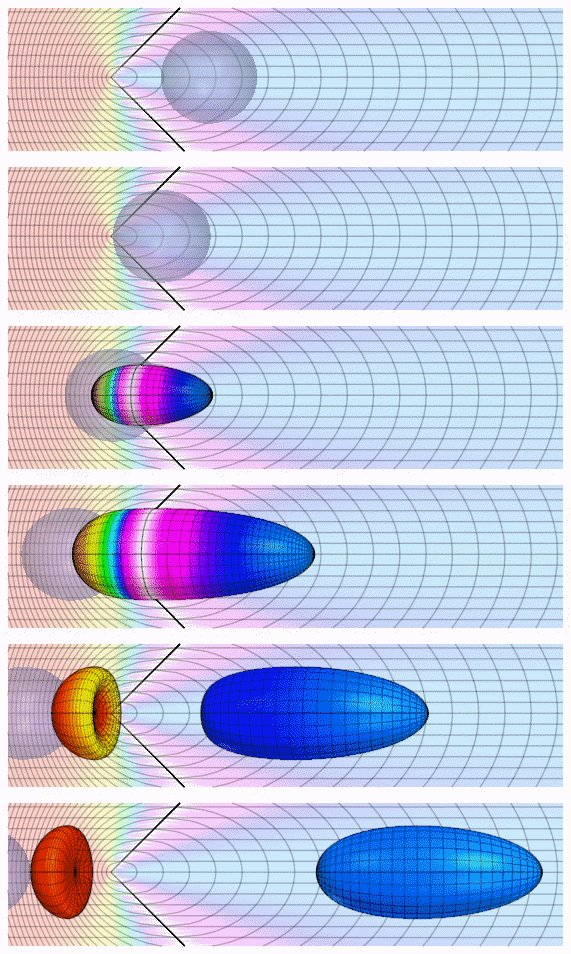
What something travelling faster than light would look like, if you could see it
But it’s not only in a Galway coroner’s court that the laws of nature have been suspended. They’re just as dysfunctional at the world’s most advanced scientific establishment – CERN.
Europe’s premier physics lab has measured particles travelling faster than light. Fancy that. This is a little troubling to them though, because for a physicist, matter moving faster than light makes about as much sense as God knocking on the door, presenting you with an iguana wrapped in newspaper, saying “Call me Susan, I have no legs for hosepipe” and turning into a forest of lemon trees. It doesn’t happen, it can’t happen, it won’t happen.
So as they make their lemonade, the boys and girls at CERN have to try to figure out where things went awry. Those particles can’t really have gone faster than light, can they? They have mass – which is a technical way of saying they weigh something – and a thing with mass can’t travel even as fast as light, never mind faster. This is because…
Well, this is because the world is a lot freakin’ weirder than it looks. You may not have noticed this – actually you couldn’t possibly – but the faster you move, the heavier you get. It isn’t detectable at the speeds even spacecraft travel at, but the effect gets more pronounced as you approach the speed of light. So pronounced in fact that if you ever travelled at the speed of light, you’d weigh an infinite amount. Which can’t be pleasant.
To make it worse, as you go faster you shrink in the direction of travel. (So much for the symbolism of the sports car then.) At the speed of light, your length front-to-back would be zero. Something with no length at all but which weighs more than the whole universe isn’t really a possible thing, so matter never can go as fast as light. The only reason light itself can manage is that it has no mass and no length to change.
Another way to think of it: The speed of light is the infinity of speed. Saying “faster than light” is like saying “more than infinity”, it’s a meaningless statement. So if this experiment showed particles of matter going from A to B in less time than light could, you’re forced to conclude that, well, perhaps A isn’t as far from B as you thought. Or maybe the particles found some sort of short cut. Or… the universe just shrunk or… something.
Those are actually genuine suggestions. Most modern theories of the universe tend to have a few extra spatial dimensions lying around; not just the Up-Down, Forward-Back and Left-Right we know, but also Hoo-Hah, Abba-Dabba and Hosni-Mubarak. Say. Maybe those extra dimensions form hidden spaces that the particles (called neutrinos) can cut through.
Or maybe not. Frankly no one knows. Any theory that accounts for a deviation from such a fundamental law has to be so darn theoretical that it may as well just be a particularly pretty form of hand-waving. Most likely explanation? They’ve simply made a mistake. They are some of the most intelligent people on the planet, they have the best lab in the world, and they’ve spent the last six months re-checking their results, but still the best explanation is that they put a decimal point in the wrong place somewhere. Almost anything is more likely than that their results are actually right.
I have a theory of my own. Of course.
CERN is headquartered in Geneva, Switzerland. That’s good, we expect things to be done with precision there. But in order to measure such high speeds, the neutrinos have to be sent to a target that’s some distance away. Quite a distance actually. Further than Switzerland is big. In Italy in fact.
Italy. Of course they’re getting figures that don’t reflect reality. Berlusconi is probably pocketing some of those neutrinos himself.
The alleged SHC victims is almost always alone, even in fictional accounts like this one of Dickens'. How come?
West Galway coroner Dr. Ciaran MacLoughlin has ruled the death of a pensioner to be Spontaneous Human Combustion. This follows his finding of a 2009 murder-suicide to be the action of “shape-shifting beings of intelligent energy”, his 2005 decision that a local man’s disappearance was caused by him being “simply pulled down into Hell”, and his opinion that the 1998 death of a lorry driver was caused by something that “mortal man wots naught therof”.
OK I made those up, but they really are no more silly than a verdict of spontaneous human combustion, a thing not recognised by science to actually f***ing exist. A coroner has entered, as the official cause of death, that a person… burst into flames.
Let’s get this clear:
Spontaneous combustion is a real – and quite ordinary – thing. It simply means that substances can catch light without any flame being introduced. This can happen in a variety of ways, heat generated by decomposition in compost heaps being a common example.
Human combustion is a real thing too. Human bodies can burn; we cremate them all the time. Though we aren’t exactly highly inflammable, it doesn’t take a terribly big fire to entirely consume a body. Our Neolithic ancestors would do it with simple pyres of wood.
Spontaneous human combustion is when a human bursts into flame without any external cause, and this… just doesn’t happen. It’s been a thing of legend for some time, and has been popularised in fiction – most significantly, Charles Dickens‘ Bleak House. The theory, perhaps “legend” would be a better word, is that some strange chemical change in the body causes it to catch light all by itself. Nobody has ever managed to recreate such a chemical reaction though.
What get labelled ‘spontaneous’ human combustion are cases where a body is found mostly or partially burned away without being on a pyre of any kind. It’s shocking, but should we really be surprised? We are partly inflammable bodies wrapped in often quite inflammable clothing. It’s perhaps surprising that we don’t catch fire more often.
There is no reason to believe that there was anything spontaneous about these conflagrations. Such bodies are often found in front of an open fire, very often the victim is a smoker. (It’s perhaps telling that reports of SHC begin only after the introduction of tobacco.) To my knowledge there has never been a case where an external source of ignition could be ruled out. Certainly not this one, where the victim was found near both matches and an open fire. (Investigators merely said that the fire did not spread from the hearth.)
Another telling thing that all these cases have in common: The victims are alone. Usually too they are very old or otherwise incapacitated (the victim in this case had type 2 diabetes, so coma is a possibility), and it seems likely that in many of these cases they are dead before the fire starts. Something sets their clothing (or the chair they are in) alight; perhaps the cigarette they were smoking, perhaps the heat of the open fire. Normally when things start to smoulder we react instinctively and quickly, but if the victim is dead or deeply unconscious and alone there is a small but real chance that smouldering can break into fire. It seems clothing fires can sometimes reach sufficient temperature to make the body’s own fats start to burn, whereupon it will to a greater or lesser extent consume itself. Animal fats make excellent fuels.
Why doesn’t the house burn down? Often it does, and so becomes another ordinary house fire caused by another ordinary stray cigarette. Just occasionally though the victim isn’t near anything the fire can spread to, and you get horrifying scenes like this.
Pathologist Professor Grace Callagy made the correct call – it was impossible to say the exact cause of death because too much of the body had been consumed by fire. We simply don’t know if he was already dead when the burning started. So for the coroner to return “spontaneous human combustion” as cause of death is quite simply ludicrous.
Prepared to be laughed at, fellow Galwegians. For this makes us look like a bunch of nineteenth-century bog goblins.
At the National Museum today, where I haven’t been since I was twelve. But then, I was pretty much twelve again when I walked through the door. Caveman stuff!
Our whole visit went on simply taking in the main hall on the ground floor, which brings you from the Palaeolithic (beginning 3-400,000 years ago), to the end of the bronze age (about 500 BC). Quite a span – but actually the palaeolithic is a bit of a cheat. It’s not thought that people actually lived in Ireland then. This is the era when tools were no more than rocks broken to have sharp edges. At that level of technology people probably didn’t have clothes, so it seems highly unlikely that they could have survived here during an ice age… Nevertheless we have a couple of what appear to be palaeolithic stone tools. It’s just that we’re not sure how they got there. Theories range from them being carried here by receding glaciers, to being carried here by mischievous archaeologists. Well the display card didn’t actually say that, but I couldn’t help feeling it was the subtext.
From this perhaps weak beginning we skip straight to the action – nearly half a million years later. Things begin to get going around 7,000 years ago with the Mesolithic, when they finally had the idea of tying rocks to sticks. If you don’t think that’s a big difference, compare the idea of trying to chop down a tree with an axe to the idea of trying to chop down a tree with an axehead. I shouldn’t talk as if they just suddenly thought of it though. It takes tools to make tools; the technology evolved in tiny gradations until a breakthrough was possible.
But these people were still nomads. It was the Neolithic that brought farming to Ireland, five or six thousand years ago, and with that the first lasting buildings, the great megalithic monuments like Newgrange, apparently part of an extraordinary culture that seems to have blossomed throughout north-western Europe for, well, for a few thousand years, and about which we now know almost nothing.
Now the stone tools were different. They were… beautiful. Some smooth, some ornately carved. These people had brought the art of banging rocks together to its apotheosis. One shocking example of their technological confidence was the Lurgan boat, the mother of dugout canoes. It’s basically a fifty-foot oak cut down, split, and hollowed out. Looked to have room for thirty people or more, a whole community.
But then bronze. The technological transition never seemed as dramatic to me as when I saw the new bronze swords and spearheads next to the old stone knives and axes. It must have been on a par with the invention of gunpowder. But it meant huge social change too. An isolated community can fashion stone tools. Bronze is made from raw materials you have to trade for.
And with this new metallurgy, gold. What ancient Irish smiths did with gold is nobody’s business. Work that could have been buried with Pharaohs has been dug out of bogs. Virtually all of it jewellery – after all, what else useful can you make from the stuff? The weird thing perhaps is that there were so few designs, speaking of a pretty unified culture. Just torcs, collars, clothing fasteners, bracelets, boss-headed “sunflower” pins and what are still known as “boxes”, though by current theory these were actually inserted in pierced ears much like the plates worn by some peoples in Africa. Except, you know, made out of gold. They were hollow and contained beads so that they’d rattle, which must have provided a constant pleasant reminder of just how rich you were. An illustration of an ancient leader decked out in all this stuff gave the distinct impression that he must have clanked like a Transformer.
And all this before history even started. Will definitely have to go back.
Uhh. Just drove back from Athenry. The GPS did a great job, but it brought me by ways I knew not. A transaction based purely on trust. Our modernised country roads; beautifully paved and marked but still crazily meandering. Blind bends you round to find that they conceal other blind bends. In the dark. In the rain. A red dot following a purple line.
A microcosm of my life in the last few days, even weeks.
Probably months.
I didn’t know where I was and I only thought I knew where I was going. But somehow, I got home.
Please excuse the brief interruption in service, owing to a family funeral. I’ll be back later today with a colour piece on what the well-dressed PC will be wearing next year.